


Activists call for boycott of firms supporting Israel's war machine
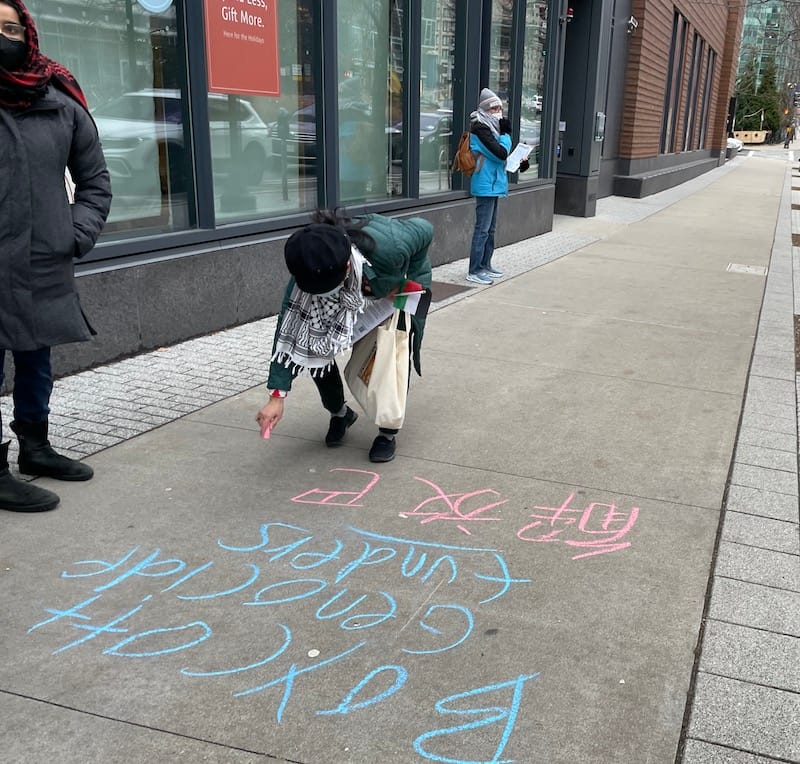
The picket line in front of Capital One was part of an ongoing weekly action organized by BDS Boston, a local chapter of a global movement aimed at boycotting, pressuring institutions to divest from and governments to sanction Israel.

On a cold December Saturday, Candace Woodson joined two dozen picketers marching in front of the Capital One Café on Seaport Boulevard, protesting the bank’s loans to Israeli arms manufacturer Elbit Systems.
Standing in front of the bank branch’s plate glass windows, she joined in the chants protestors were shouting.
“When drones fly, people die,” they sang, “and Elbit’s profits multiply.”
Why drive nearly an hour from a Boston suburb to stand in sub-freezing temperatures and protest?
“Everyone should be able to live without being bombed and should be able to eat,” Woodson said. “Genocide is wrong. Colonization is wrong.”
Since the outbreak of its latest siege of Gaza, the Israeli army has conducted a war that is widely seen as genocidal, killing over 64,000, most of whom were women and children, destroying infrastructure including hospitals, schools and refugee camps and flattening entire cities in the territory of 2 million and severely restricting food aid.
Elbit Systems, Israel’s largest weapons manufacturer, produces weapons that have been used in what international observers say are war crimes, including white phosphorus munitions which Isreal has used on civilians.
The picket line in front of Capital One was part of an ongoing weekly action organized by BDS Boston, a local chapter of a global movement aimed at boycotting, pressuring institutions to divest from and governments to sanction Israel in response to its military occupation of Palestinian territory, its ongoing expropriation of Palestinian land and its discriminatory policies against Palestinian citizens of Israel that Israeli and international human rights groups say constitute a form of apartheid.
As Israel’s bombardment of Gaza intensified from 2023 to 2025, so too did the global boycott, divestment and sanctions movement. Demonstrators in Britain vandalized an Elbit Systems weapons plant and were cleared of aggravated burglary charges in February. Dock workers in Spain, Morocco and Oakland, California have refused to load cargo on ships carrying weapons and munitions to Israel.
“We know that corporations and civilian infrastructure like ports, institutions like retirement funds and universities are complicit in the arms trade,” said Lea Kayali a Boston-based organizer with the Palestinian Youth Movement. “Part of what we do is to hone in on targets we can win.”
Locally, the movement has scored some wins. After students and community members mounted a pressure campaign against MIT last year, the university severed ties with Elbit systems. Elbit had been enrolled in MIT’s Industrial Liaison Program, giving the firm access to MIT researchers and professors. BDS Boston demonstrators also picketed Elbit’s Central Square office, forcing the firm to vacate the building.
Liza Behrendt, an organizer with BDS Boston, says such victories are important for the global movement.
“The cumulative impact of millions of people engaging in the BDS movement globally is making a difference, even as the reality on the ground for folks in Palestine continues to be discouraging,” she said.
Within Capital One, the bank’s cozy relationship with the Israeli military has sparked opposition. Bank employees formed a group, Capital One Associates Against Genocide, and are pressuring the bank to sever its ties with Elbit through an open letter posted internally that received hundreds of signatures. Capital One took down the letter, according to an employee who spoke to The Flipside on the condition of anonymity.
“There has been a concerted effort to raise awareness within Capital One about its complicity in the genocide,” the employee said.
Despite the letter and the resignation of several employees who posted their own letters on the company’s slack channel, the company has not directly addressed the employee’s concerns about its investments in Elbit.
“My theory for where change can occur has shifted away from the company,” the employee said. “If there comes to be a cost that makes them feel like they’re being negatively impacted, then change might occur.”
That scenario played out in South Africa during the 1970s and ’80s as activists around the world engaged in a similar divestment campaign against companies doing business with the formerly apartheid regime. In the United States, divestment efforts began with employees at Polaroid’s Cambridge office, who highlighted that company’s contracts supporting the South African government’s passbooks that Black citizens there were required to carry.
Polaroid ended its business with the South African government, and the movement grew to include colleges, state and local governments and other major corporations withdrawing from investments in companies doing business with the apartheid regime.
Facing financial and social pressure from universities and governments, businesses withdrew from South Africa. Increasingly economically isolated, the South African government ended apartheid in 1991.
Michel DeGraf, a professor of linguistics at MIT who is active in the BDS movement, said similar pressure can be brought to bear on Israel.
“When you look at Israel’s economy, it cannot survive without the United States,” said. “If businesses in Tel Aviv see how they’re being seen in the world, they will pressure the government to change. Israel’s economy relies heavily on outside trade.”
Capital One is one of many U.S. corporations that support Israel’s military aggression in Gaza, the occupied West Bank, Iran, Lebanon and other neighboring countries. In Boston, health care workers and members of the group Jewish Voice for Peace last week marched from the Israeli consulate in Park Square to the offices of Sheba ARC, an Israeli national health care company that activists say partners with Elbit and indirectly supports Israel’s war machine.
The local BDS movement in recent years has targeted other firms that organizers say support Israel’s apartheid regime. As part of an international effort, local activists organized pickets in front of Puma’s Assembly Square store in protest of the sportswear manufacturer’s sponsorship of the Israeli Football Association, which includes teams operating in Israeli settlements on Palestinian land. The company ended its sponsorship with IFA last year.
The wins haven’t been easy for U.S. BDS activists. Thirty-seven U.S. states have passed anti-boycott laws that penalize businesses and organizations that enact or call for boycotts of companies doing business with Israel. But efforts to pass such a law in Massachusetts have failed. Voters in Somerville last year passed a non-binding resolution calling on the city to divest from companies that “support Israel’s apartheid, genocide and illegal occupation of Palestine.”
BDS Boston organizer Behrendt remains confident that activists’ weekly boycotts, combined with those held in cities around the country, are effective.
“I think our disciplined consistency as Palestinian solidarity activists with what’s going to make a difference,” she said.


