


City hasn't disclosed BPD's communications with feds
Three Boston city councillors last week filed formal requests for information from the Boston Police Department about its collaboration and information sharing with federal law enforcement.

Three Boston city councillors last week filed formal requests for information from the Boston Police Department about its collaboration and information sharing with federal law enforcement. They also sought hearing orders calling on BPD brass to explain the degree to which they collaborate with federal immigration officials.
The focus of their inquiry is the Boston Regional Intelligence Center (BRIC), a clearinghouse of information and office space that Boston Police officers share with federal agents, including an officer assigned to the Department of Homeland Security.
While Boston’s TRUST Act — enacted in 2014—forbids Boston Police from cooperating with federal immigration officials on civil immigration enforcement, activists have long suspected that Boston Police officers collaborate with ICE by turning over to immigration authorities people who have not been convicted of a crime.
Councillors Ben Weber and Henry Santana last August filed a formal “17F” request for information on all memoranda of understanding between federal agencies and the City of Boston, including but not limited to the Department of Immigration and Customs Enforcement.
Six months later, Weber and Santana say they have not had a response to their request.
Last Wednesday (Feb. 26), they refiled the request, again using the 17F process, which requires city agencies to respond to the council within ten days.
The city’s delay in furnishing information fits into a wider pattern of the Boston Police Department’s surveillance of city residents and the department’s collaboration with federal agencies, notes Fatema Ahmad, executive director of the Muslim Justice League.
“It’s yet another example of this administration and the BPD not responding in a timely manner to the Boston City Council,” she said.
In a report to the Council last July, BPD officials admitted to repeatedly deploying social media surveillance technology without first notifying the municipal legislature, as required by a law passed in 2022.
Boston Police officers have in the past conducted surveillance on Boston residents, including Muslim-Americans, activists protesting police brutality, and people demonstrating against Israel’s siege of Gaza, which human rights groups and the UN Independent International Commission of Inquiry on the Occupied Palestinian Territory have declared a genocide.
During last week’s Council meeting, at-large Councillor Julia Mejia filed an order for a hearing on how BPD collects, uses, protects, and shares information that may be requested by external entities.
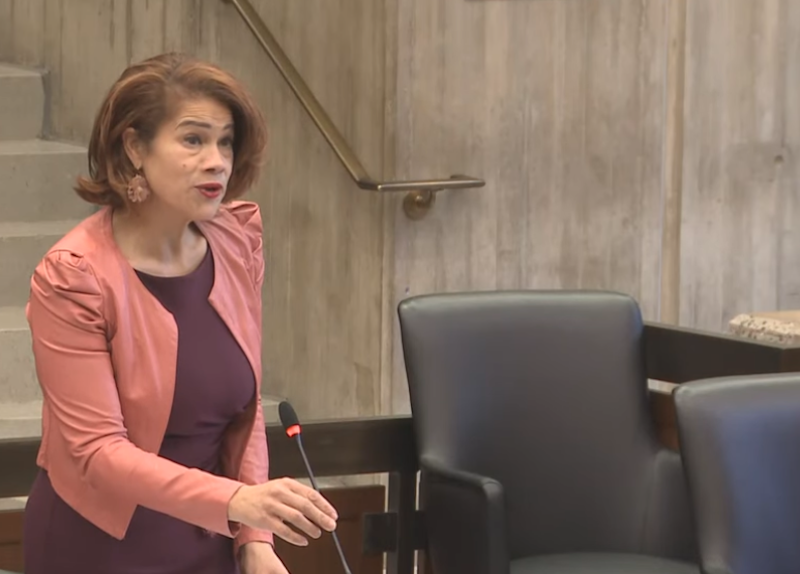
“As members of this council we have sworn to uphold the Constitution,” Mejia said, introducing the hearing order. “That requires active oversight of the city’s intelligence and surveillance infrastructure.”
Over the last year, as the Trump administration has dedicated unprecedented resources to detaining and deporting immigrants — often without regard for their legal status — councillors have increasingly questioned the city’s involvement in the BRIC and its posture with federal law enforcement.
Last August, Mayor Michelle Wu moved forward with a request for a $12 million federal Urban Areas Security Initiative grant to fund the BRIC, despite the Trump administration’s requirement that 10 percent of the funding be applied toward supporting collaboration between state and local law enforcement and federal immigration officials.
In a post on the BlueSky social media platform, Wu said the BRIC could satisfy that requirement by collaborating with federal immigration officials working on harbor security.
But activists worry that Boston Police may already be feeding information to ICE agents in other ways. Through the fusion center, police share intelligence reports on protests. While the city forbids collaboration with ICE, other federal law enforcement such as the FBI have access to the reports. FBI agents work with ICE and have accompanied ICE agents on immigration raids.
Others on the City Council share the activists’ concerns.
“Information shared between the BRIC and the Boston Police Department must be carefully scrutinized to make sure it does not infringe on the civil rights and liberties of Boston’s residents, particularly those in vulnerable communities,” District 7 Councilor Miniard Culpepper said during last week’s meeting.
The Council last month passed a resolution in support of the PROTECT Act, legislation drafted by the Massachusetts Black and Latino Legislative Caucus, that would bar police in the state from conducting civil immigration enforcement. Members voted down a 17F request proposed by District 2 Councillor Ed Flynn seeking copies of immigration detainer requests that federal immigration officials have sent the Boston Police Department. Police officials have told the Council they have rejected all such requests.
This article was originally published in the Dorchester Reporter.


