


Community members express ire over city's White Stadium plans
To critics who turned out to the mid-afternoon meeting in the City Council’s Ianella chamber, the deal the Wu administration negotiated with a group of wealthy investors represents an unwise investment of city resources.

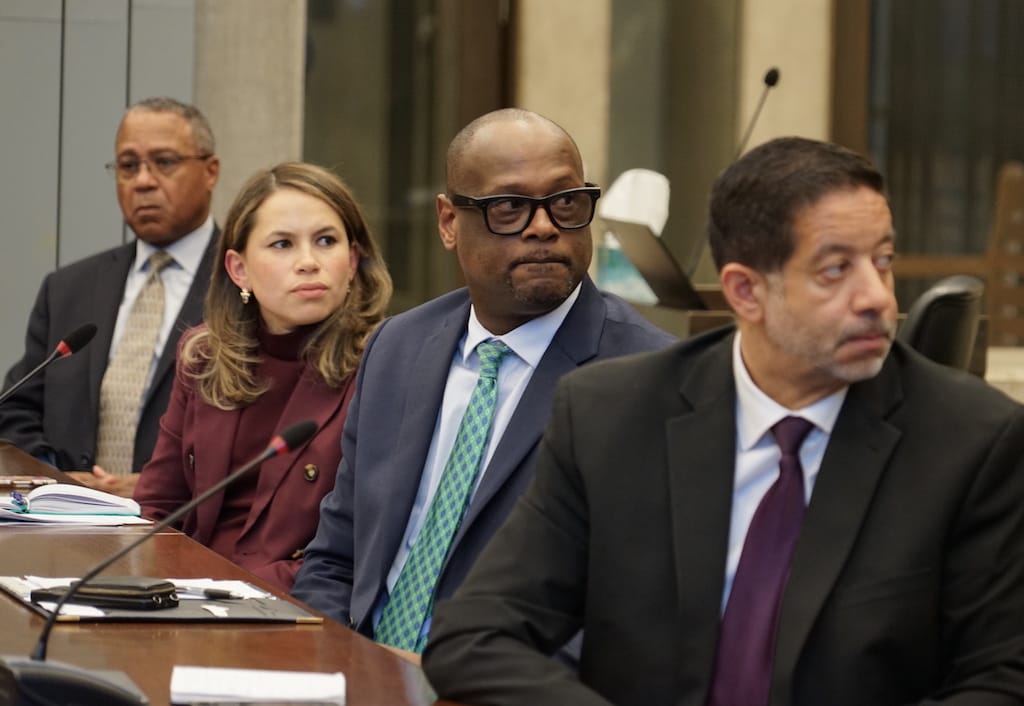
The city of Boston’s lease agreement with a women’s professional soccer team for the use of White Stadium represents a $190 million benefit that will give Boston Public Schools students nearly unrestricted access to a state-of-the-art sports facility, city officials said during a Monday hearing about the project.
“Beyond what this means for our students, this partnership delivers the largest community benefits package ever secured — $190 million in private capital to reconstruct the stadium prioritizing local minority – and women-owned business,” said Dion Irish, chief of operations for the city.
But to critics who turned out to the mid-afternoon meeting in the City Council’s Ianella chamber, the deal the Wu administration negotiated with a group of wealthy investors represents an unwise investment of city resources.
“This project is often described as a public/private collaboration between the city and the soccer ownership group,” said John Smith-St. Cyere. “But when the surrounding community is pushing back, when residents are testifying in opposition, and when councillors themselves are still trying to understand the details, it is hard to call that a true collaboration. What it begins to look like instead is the mayor’s administration deciding what it needs is best for our community.”
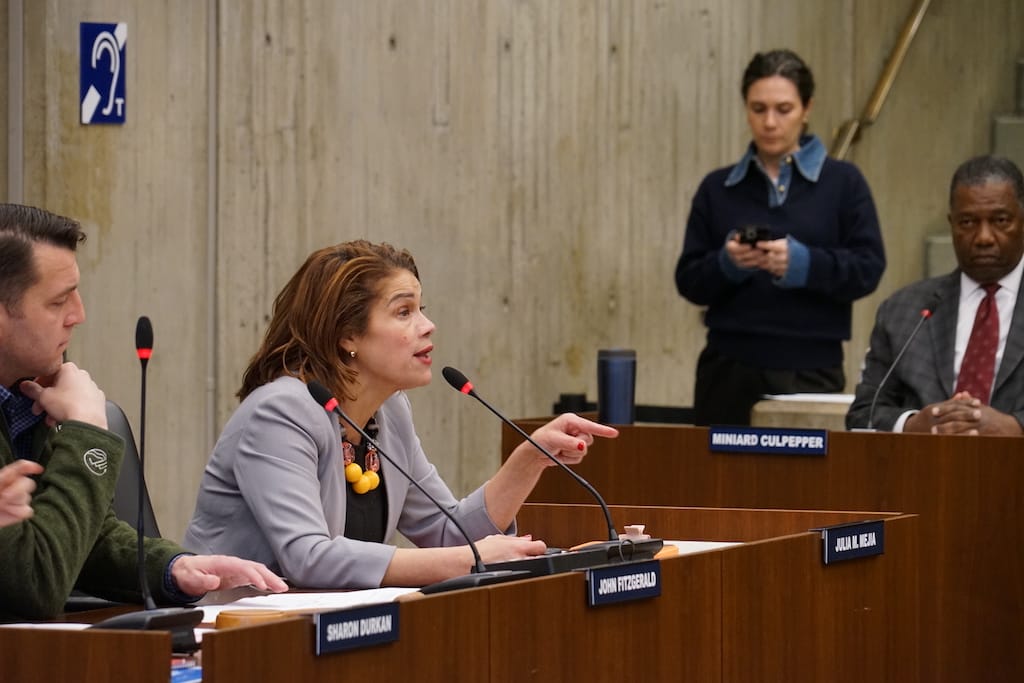
Those who testified in the hearing, which took place over more than three hours, spoke overwhelmingly in opposition to the city’s plan to lease the stadium to Boston Unity Soccer Partners, which would host 20 games a year and operate a beer garden and other concessions on the site of the stadium.
The testimony of opponents contrasted sharply with that of city officials and city councilors, the majority of whom support the project.
“Let’s be clear about who this stadium is for,” said District 6 Councilor Ben Weber. “It’s for BPS and the public.”
Opponents noted that BPS football teams, which have been using the stadium for games since it was first opened in 1949, would not be able to play there during their regular seasons. Victoria Lamarche-Wright, who runs track for the O’Bryant School of Math and science, said the city’s $135 million investment in the 11,000-seat stadium is misplaced.
“We deserve a better facility, but I don’t need a professional soccer team in my space,” she said. “I actually want to see money go into our BPS schools. I go to the O’Bryant. Every time it rains, there’s water leaking into our school. There’s water, there’s mold, but we’re focused on a soccer team.” Opponents have also raised objections about putting limits to public access to the park and the prospect of unmanageable traffic and parking restrictions on game days.
Franklin Park Defenders, a group supported by the Emerald Necklace Conservancy that is suing the city over the project, hired an architect to design an alternative plan for the stadium exclusively for the use of student athletes. Proponents say that plan — sketched out before the city tore down the western grandstand of the old stadium— could have cost far less— approximately $29 million.
Under the approved lease agreement, Boston Unity Soccer Partners will have exclusive use of the interior of the new western grandstand. Boston Public Schools will use a new eastern grandstand as the headquarters for its district-wide athletics department. The eastern grandstand will also include locker rooms and showers for BPS students, a fitness center and a sports medicine center.
The city’s plan has its boosters. Marvin Dee Mathelier, part owner of Café Ula in Jamaica Plain, thinks the professional soccer games will be a boon for local businesses.
“The 11,000 people who come to White Stadium aren’t just going to park and leave,” he said. “They’re going to walk through our neighborhoods. They’re going to walk through Egleston Square. They’re going to walk through Blue Hill Ave. They’re going to walk through Jamaica Plain. That means thousands of people moving through one of the most diverse small business corridors in Boston.”
Jamaica Plain resident Renee Stacey Welch, a member of Franklin Park Defenders, said studies have shown that stadiums have traditionally produced little economic benefit for host communities.
“Large stadiums do not necessarily benefit these businesses,” she said. “In fact, in many cities, the opposite occurs. Stadium operations often bring in outside vendors, corporate concessions in controlled event environments where spending happens inside the venue rather than in surrounding neighborhoods.”
City officials plan to rely on shuttle buses and remote parking areas to get patrons in and out of White Stadium, which will have no on-site parking on game days. The city is also considering instituting a parking ban on an area as wide as a mile around the stadium from on game days.
The transportation plan the city prepared for the stadium would have as many as 140 shuttle buses bringing visitors from MBTA stations and satellite parking areas to drop off points in the park off of Walnut Avenue and in a lot on Circuit Drive. Ride share drivers would be expected to drop off and pick up customers at the intersection of Humboldt Avenue and Seaver Street.
“I feel like this project is going to impact our civil liberties,” said Melissa Hamil, who said the parking ban would restrict residents’ ability to host parties or cookouts on game days.
Some who testified Monday complained of what they said was a lack of community process. While the city held no public meetings before drafting the request for proposals — for which Boston Unity Soccer Partners was the only respondent — city officials held online meetings after the group was designated, but often gave participants no chance to weigh in.
Irish said city officials have listened to community concerns and made changes to their plans for the stadium in reaction to input they’ve received from community members.
Reggie Stewart, a public affairs specialist from Dorchester, said the lack of community participation in decision-making around the White Stadium deal fits a broader pattern with the Wu administration not listening to community concerns, citing Parcel P3 in Roxbury where, in January, Wu announced the city would build a new Madison Park High School building, effectively scuttling community-approved plans to build out housing and lab space there.
“Unfortunately, these are processes that our mayor has seen fit to skirt or outright ignore,” he said. “The mayor is unilaterally making decisions and declarations regarding Madison Park and Parcel P3, breaking decades-old agreements and fracturing an already fragile trust with the Black community. Many rightly see this as a continuation of a longstanding pattern of racist governance on the part of this administration.”
Stewart said Wu had crossed a red line with the Black community. “The question now is whether the Council will cross that red line as well,” he said. “Right now, when it comes to trust with Black Boston, city leadership, frankly, is skating on the thinnest ice.”
Several who testified echoed Stewart’s anger at what they said were unilateral decision made by the Wu administration.
“It is my observation that the mayor, supported by her rubber-stamping puppets, does what she wants to do regardless of what the community wants — especially when it comes to the Black community — with no effective checks and balances of power,” said Hyde Park resident Sharon Hinton.


