


Franklin Park Defenders outline complaints ahead of April 8 court date
Franklin Park Defenders plan to argue that the stadium is surrounded by public park land and that any alterations are subject to Article 97 of the state constitution, mandating an environmental review and the approval of two-thirds of the Legislature.

When activists opposing Mayor Michell Wu’s leasing of White Stadium make their case in Suffolk Superior Court next week, they plan to argue that the stadium is surrounded by public park land and that any alterations are subject to Article 97 of the state constitution, mandating an environmental review and the approval of two-thirds of the Legislature.
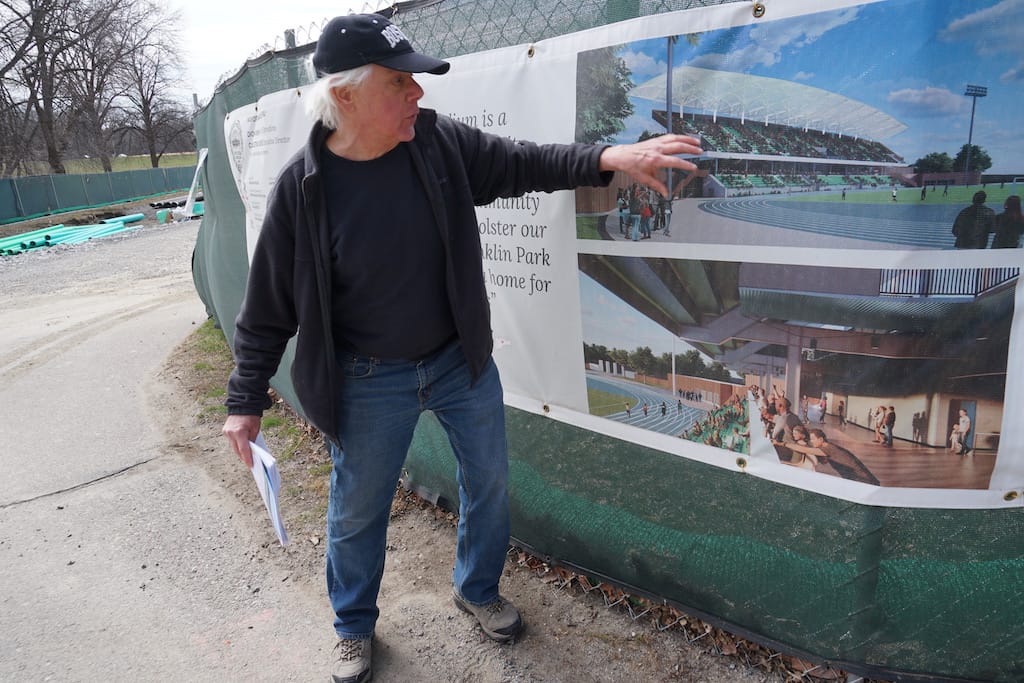
On Monday, members of the Franklin Park Defenders group, including plaintiffs in the case, told reporters that contractors for the city and Boston Unity Soccer Partners have already encroached on park land as their construction is well underway.
The Wu administration last year prevailed in Suffolk Superior Court, arguing that the stadium is on land that belongs to the Boston Public Schools and, therefore, is not subject to Article 97 restrictions against the privatization of public park land. Franklin Park Defenders appealed the decision and will argue that the stadium is surrounded by public park land and is, therefore, subject to the restrictions.
“This is public parkland, all of it,” said Jamaica Plain resident Melissa Hamel, showing reporters a map from the city’s 2023 Open Space and Recreation Plan. “By the city’s own admission, by constitutional law. Fifty years ago, Article 97 was created to protect parkland. This is not protecting parkland.”
Behind Hamel, the facade of the western grandstand stood in front of excavators and earth moving equipment assembled on the former football field of what was the 1949 George Robert White Stadium. Running under the roadway surrounding the stadium are new water, sewer and utility lines installed by contractors for the city and BUSP. They are needed for the new soccer stadium that is designed to hold 11,000 spectators, a beer garden and restaurant.
Those alterations, as well as the BUSP and city’s plan to use the roadways around the stadium for shuttle buses bringing in fans, trucks for broadcast media and deliveries for the stadium and restaurant represent major alterations to the parkland, the advocates insist.
Beyond the eastern side of the former stadium, fencing for the project has extended into the Playstead area of the park. Renee Stacey Welch, a plaintiff, noted that the area is the scene of multiple events during the summer — the BAMS Festival, the Dominican and Puerto Rican festivals as well as Playhouse in the Park concerts and events. It also hosts ball games, cookouts, family reunions, birthday parties and other informal events.
“I grew up playing cricket on this field,” Welch said. “You see people flying kites, walking dogs.”
“There was so much talk in the Franklin Park Action Plan about building on the arts and the activities that already happen here,” said Priscilla Andrade, who lives less than a block from the park. “Now the city is talking about Franklin Park like it’s a vacant lot full of rats. There’s a long history of Frankling Park being here for events and picnics. By leasing the stadium to a soccer team and making everything else work around it, they’re dishonoring that legacy.”
The soccer team plans to play 20 games a year in the stadium. While many games will be held on weekends, some will be held on weekdays. Under the city’s current plan, on game days parking will be restricted in the park and within a radius of up to a mile-and-a-half from the park, which critics say would severely restrict the activities and events that typically take place in and around the park.
People who register their cars to an address within the radius around the park will be given White Stadium Area parking permits and one guest permit per household. On game days, parking will be restricted for two hours before a game starts and for an hour after it ends. Cars in violation will be ticketed and towed.
People wishing to use the park for recreational activities will be allowed a 90-minute pass to do so on game days. The abutters say people who use the park for cook-outs, tennis matches, basketball or other informal activities typically remain in the park for more than 90 minutes. They’re also unlikely to bring the grills and coolers used for cookouts or the bats and wickets used for a cricket match to the park on a bus, Welch said.
Those who pay for a zoo pass or use the golf course will have permits allowing them to stay in the park indefinitely, according to the city’s plan.
In addition to the restrictions on the use of the park, members of the Franklin Park Defenders also highlighted what they said would be restrictions on the use of the stadium itself, which the Wu administration has characterized as a “generational opportunity to anchor citywide youth sports programming.”
“What public school stadium has a beer garden and private box seating?” said Roslindale resident James Mealey. “The primary goal of this project is to benefit the wealthy owners of the soccer team.”
Although the stadium was designed for football and has hosted games from its 1949 opening until it closed for construction in 2024, students will no longer be able to play on the field during the soccer season, which goes from March till November, as their cleats would compromise the quality of the field. While city officials say BPS can negotiate around scheduling, critics of the plan say the National Women’s Soccer Leage schedule would likely dictate when matches happen in the park.
Members of the Franklin Park Defenders are hopeful their case will prevail next week.
Melissa Hamel cited an Oct. 10, 2022 email to then Chief of Economic Opportunity and Inclusion Segun Idowu in which BUSP principal Jennifer Epstein appears to strategize around skirting the Article 97 process before the city released a request for proposals for the redevelopment of the stadium.
The plaintiffs are asking that the proposed changes to the use of White Stadium and the land around it to be subject to the review process and a vote in the Legislature required in the state constitution.
“We’re asking them to follow the Article 97 process,” Hamel said.
This article originally appeared in the Dorchester Reporter.


