


Governor advances legislation, executive order to curb ICE
One day after the Massachusetts Legislative Black Caucus announced legislation aimed at curbing local cooperation with ICE, Gov. Maura Healey held a State House press conference unveiling her own executive order and legislation to rein in federal immigration agents.

One day after the Massachusetts Legislative Black Caucus announced legislation aimed at curbing local cooperation with ICE, Gov. Maura Healey held a State House press conference unveiling her own executive order and legislation to rein in federal immigration agents.
Healey’s legislation would bar warrantless civil arrests by ICE in court houses and make it illegal for ICE agents to enter schools, day care centers, hospitals, health centers and churches without a judicial warrant. The legislation would also make it illegal for a national guard unit from another state to deploy in Massachusetts without the Massachusetts governor’s permission.
Her executive order would block any state office or agency from entering into a new 287(g) agreement — which effectively authorizes prisons to house ICE detainees — unless there is a certified public safety risk or need. It would not end the Plymouth County House of Correction’s existing agreement with ICE.
“We’re standing up for our immigrant communities, for a part of the fabric of our communities that contribute so much to our culture, to our economy, to who we are,” Healey told reporters. “We’re standing up for public safety, and for education and healthcare, and the ability of people to freely practice their faith. We're standing up for the liberties that we hold dear and for the protections we deserve and the places where we go in need to feel safe.”
Asked by reporters how the state would enforce its ban on ICE agents in courts, on state and private property, Healey said she hoped the state law would serve as a deterrent.
“My hope today is that in signing this executive order we make clear here in this state we have sensitive areas,” Healey said. “We expect the federal government, Donald Trump, Kristi Noem and ICE agents to respect our sensitive areas.”
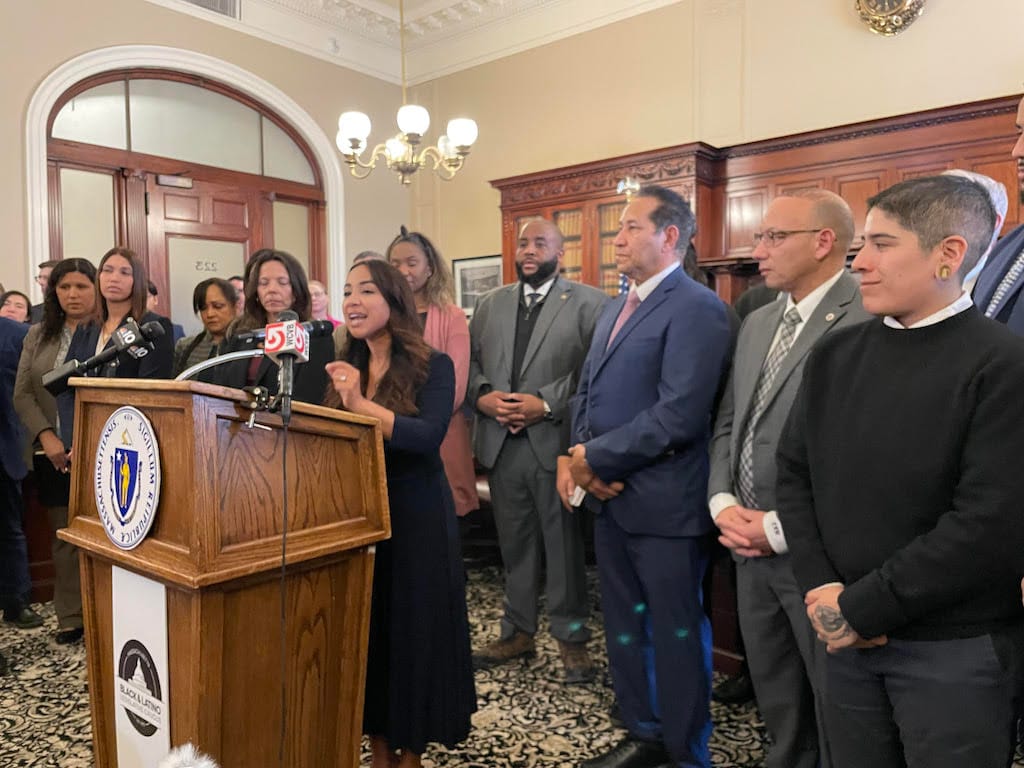
The PROTECT Act, announced by the Black and Latino Caucus Thursday, would bar local police from cooperating with ICE on civil immigration enforcement, as well as barring ICE agents from making arrests at court houses without a judicial warrant.
Black and Latino Caucus Vice Chair Sen. Liz Miranda, who was not present at Healey’s announcement, said she appreciates Healey’s effort in the midst of ICE incursions into major U.S. cities.
“She understands Massachusetts could be next,” Miranda said of Healey.
Miranda said she is hopeful that Healey will work with members of the Black and Latino Caucus to advance portions of their PROTECT Act, such as the provision barring all police cooperation with ICE on civil immigration enforcement.
“The 26 members of the Black and Latino Caucus know their districts well,” she said. “We hope she understands this.”
Miranda, who has been filing versions of the Safe Communities Act over the last seven years, noted that Cape Verdeans in her district last week received an email notifying them of an impending ICE action. While it’s unclear from where the email was sent, the message sparked panic in the community.
Other caucus members represent districts that are heavily Haitian, Latino and Brazilian.
As is the case with Healey’s executive order, the PROTECT Act would not terminate the agreement the Plymouth County House of Corrections has with ICE to hold criminally charged detainees. Miranda said many caucus members have constituents who advocated for that agreement to stay in place so they would be able to visit family members in detention.
The PROTECT Act would ban state and local agencies from entering into any future 287(g) agreements with federal immigration authorities.
Miranda said the PROTECT Act would mandate that detainees have access to interpretation services and to lawyers. The caucus legislation would also require the prison to track detainees so family members and advocates can locate them more easily.
Hours before Healey’s announcement, a coalition of activists rallied at the State House in support of existing immigrant protection legislation, including the PROTECT Act.
“The Black and Latino Caucus has clearly put in a lot of work in terms of stakeholder engagement,” said Progressive Massachusetts Policy Director Jonathan Cohn. “They enter the space with a lot of political capital and legitimacy.”
In her press conference, Healey struck a tough-on-crime tone, but noted that ICE agents are primarily targeting people without criminal histories. Healey, who is facing two Republican challengers in her bid for reelection this year said she supports the mission of ICE, but not the way the Trump administration is deploying the agency.
“Ice is supposed to be doing his job, protecting our borders, right?” she said. “They have a job, which I support that mission. But that's not what they're engaged in right now. So I say Donald Trump needs to bring everybody home, bring them out of these communities.”


