


Governor releases draft graduation requirements
One year after voters passed a ballot referendum barring the state from using the MCAS exam as a graduation requirement, Gov. Healey joined education officials at Dedham High School Monday to announce a proposed new framework for graduation requirements.

One year after voters passed a ballot referendum barring the state from using the MCAS exam as a graduation requirement, Gov. Healey joined education officials at Dedham High School Monday to announce a proposed new framework for graduation requirements that would include course work aligned with college admission standards.
The draft recommendations also include a capstone, or portfolio, project and end-of-course assessments (EOCs) that would be designed, administered, and scored by the state. The draft recommendations do not call for use of the state-designed and administered assessments as a graduation requirement.
“We’re moving away from high stakes to high expectations and seizing this moment, this opportunity to reach all of our students and make a Massachusetts high school diploma more meaningful than ever,” Healey said in addressing an audience at Dedham High School.
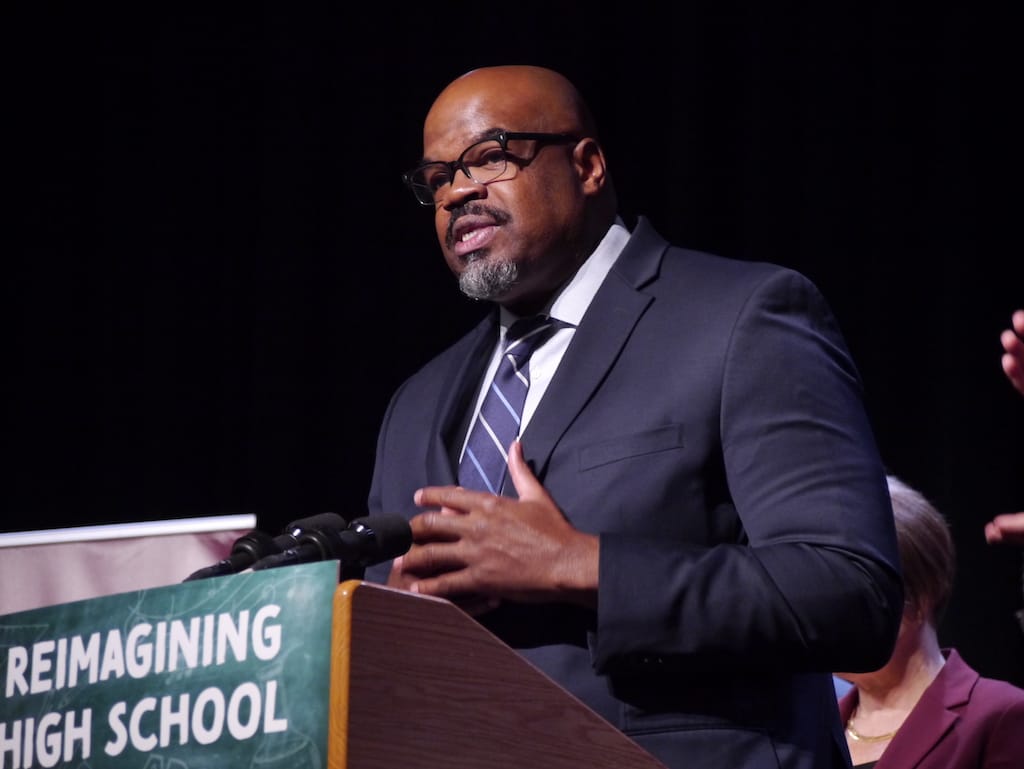
Speaking from the stage with Healey, American Federation of Teachers Massachusetts (AFT) President Jessica Tang expressed cautious optimism and referred to the draft proposal as “a starting point.”
“Our hope is that the final recommendations accurately reflect what we know residents want: a better graduation system that moves away from high-stakes testing,” she said. “There is an opportunity here to create a better system that authentically reflects and supports the current educational needs of our students, including a focus on deeper learning, critical thinking, lifelong learning and preparedness for college, vocation, and career.”
State officials drafted the proposal by drawing from recommendations from the governor’s Graduation Council — a group that included representatives of teachers unions, business groups, teachers, and parent groups. Under the draft, high school students would complete EOCs as they finish course work that is required for graduation. The EOCs would enable schools to better assess student’s needs before graduation, Healey noted.
“It includes exams that are not high stakes, but are the actual course you just took,” she said of the proposed assessment system. “That will also allow us to phase out MCAS in 10th grade.”
The Massachusetts Teachers Association, the state’s largest union, issued a statement cautioning against the inclusion of state-developed and graded EOCs.
“The proposals for new graduation requirements, written by Secretary of Education Patrick Tutwiler and Commissioner of Elementary and Secondary Education Pedro Martinez, include valuable ideas promoted by educators, parents, community advocates, and educational experts, and are strongly supported by the MTA,” wrote the union’s president, Max Page and vice president, Deb McCarthy in a statement sent to news media.
“But by making new state standardized tests a central component of the new graduation requirements,” they said, “the proposal defies the will of voters who made clear their wishes in the 2024 Question 2 referendum, which passed by nearly 60 percent in favor.” That approval bars the state from using the MCAS exam as a graduation requirement.
Groups backing that ballot question argued that many Massachusetts schools and districts had become so laser focused on the exam that they had narrowed their curricula to test preparation aimed at pushing students to pass the math, English language arts, history, and science portions of the exam.
Under the current system, schools that score in the lowest percentiles on the MCAS exam are subject to state interventions in which up to half their teachers can be fired. The state’s record of receivership of schools and district has had, at best, mixed results with several districts remaining under state control for years with little improvement in students’ MCAS scores.
Business advocacy groups such as the Massachusetts Business Alliance have argued in favor of keeping the MCAS exam as a graduation requirement, arguing that the test held students, teachers, and schools to a higher standard.
Representatives of groups opposing the MCAS exam and supporting the continued use of such a test came together as part of the governor’s Graduation Council for a series of meetings over the last several months to hash out the new draft graduation requirements. Education Commissioner Patrick Patrick Tutwiler, who co-chaired the Graduation Council, will make the final recommendations to the governor.
“What we’re releasing today, as the governor said, is an initial framework, a starting point,” Tutwiler told the gathering at Dedham High School. “It outlines the importance of course work and offers more opportunities for students to demonstrate their learning in ways that reflect their strengths and supports them in planning the next chapter of their lives, whether that’s higher ed or entering the workforce.”
In addition to the new assessments, the draft graduation requirements include course work that prepares students for college, a requirement that students maintain an “individual career and academic plan,” complete paperwork for state and federal financial aid, and develop skills in financial literacy.
Healey made no mention of whether the state would provide additional funding for these requirements.
Jason Fraser, vice president of the Massachusetts Association of School Committees, expressed support for the end of course assessments as a replacement for the MCAS test, so long as they aren’t used as a barrier to graduation, but cautioned against the Department of Elementary and Secondary Education advancing new requirements and coursework without additional funding.
“We agree with Commissioner Martinez that EOCs could help identify students at risk of not graduating and ensure those learners receive timely supports,” he wrote in a statement. “But this requires equitable funding and flexibility for districts to provide necessary interventions.”
In her remarks, Healey said the new requirements are not an unfunded mandate from the state.
“For our district and school leaders, this isn’t about reinventing the wheel and it’s not about mandates,” she said. “What it is about is drawing on the strings that make our schools number one in the country and working with all of you to bring them to every student in our state.”
Administration officials aim to complete the new requirements by June of next year.
This article was originally published in the Dorchester Reporter.


