


Lawmakers consider bill that would end state takeovers of school districts
State takeovers of schools and school districts are widely seen as ineffective. Lawmakers are considering bills that would end the practice in Massachusetts.

Fourteen years after the state’s Department of Elementary and Secondary Education (DESE) first put a school district in receivership, education activists are now pushing for an end to the practice, citing the state’s checkered record of running schools and districts and the loss of local control.
“Instead of working with the school and community to address areas in need of improvement and provide support, the receivership model adds layers of bureaucracy which stifle collaboration,” said Jessica Tang, president of the American Federation of Teachers Massachusetts (AFTM) in testifying during a Nov. 12 hearing before the Joint Committee on Education.’
“The bottom line over a decade’s worth of data is clear,” she said. “It hasn’t worked.”
The districts in Lawrence, Holyoke, and Southbridge have undergone receivership. In Springfield, the state put a consortium of schools under partial receivership. In none of the instances did districts or schools move from the bottom of the state’s ranking of districts, despite years of state intervention.
When districts and schools are placed under receivership, the state appoints an individual or education management firm that operates largely independently of the district and has the power to fire principals and teachers in schools as well as make changes to the hours of operation and curriculums. Schools and districts are ranked primarily according to students’ MCAS scores on five levels. Level 5 schools and districts are subject to receivership.
Critics of that system have long maintained that the over-reliance on MCAS scores doesn’t determine school performance and fails to account for factors such as the students’ growth in MCAS scores. If a school or district has a high population of English language learners, for example, students taking the MCAS exam will score low but improve over time. By weighing overall scores over the growth in scores, the state’s system doesn’t show where instruction is actually improving student outcomes.
The Thrive Act, whose sponsors include state representatives Sam Montaño of Boston and Jim Hawkins of Bristol and senators Liz Miranda of Boston and Adam Gomez of Springfield, would modify the process of state intervention. Under the act, student growth on the MCAS exam would have to be afforded at least as much weight as overall scores.
The legislation would require that no more than 5 percent of schools or districts be designated “in need of comprehensive support” at any given time. It would end the state’s direct control over school interventions and instead require that school superintendents and local stakeholders convene to develop an improvement plan and require the state to provide funding above a district’s normal Chapter 70 allocation.
The Thrive Act also calls for the creation of a special commission to study and make recommendation for a “more authentic and accurate system for assessing students, schools, and school districts.”
In Boston, the Dever and Holland schools underwent state receivership. In 2014, DESE appointed a Newton-based education management start-up called Blueprint as receiver. The firm cycled through five principals in its first two years of supervision, the schools remained in Level 5 status — the lowest in the state’s ranking system — and enrollment dropped from 583 students to 498.
In 2023, the Dever remained in “chronically underperforming status. Then in January of this year, district officials announced plans to close the school.
The Holland got off to a rocky start under receivership, with the Up Education Network that administered the school suspending more kindergarteners there than in any other school in the state with an overall suspension rate more than three times higher than the state average. The school is still under a state turnaround plan, although test scores at the school are only slightly below the district average.
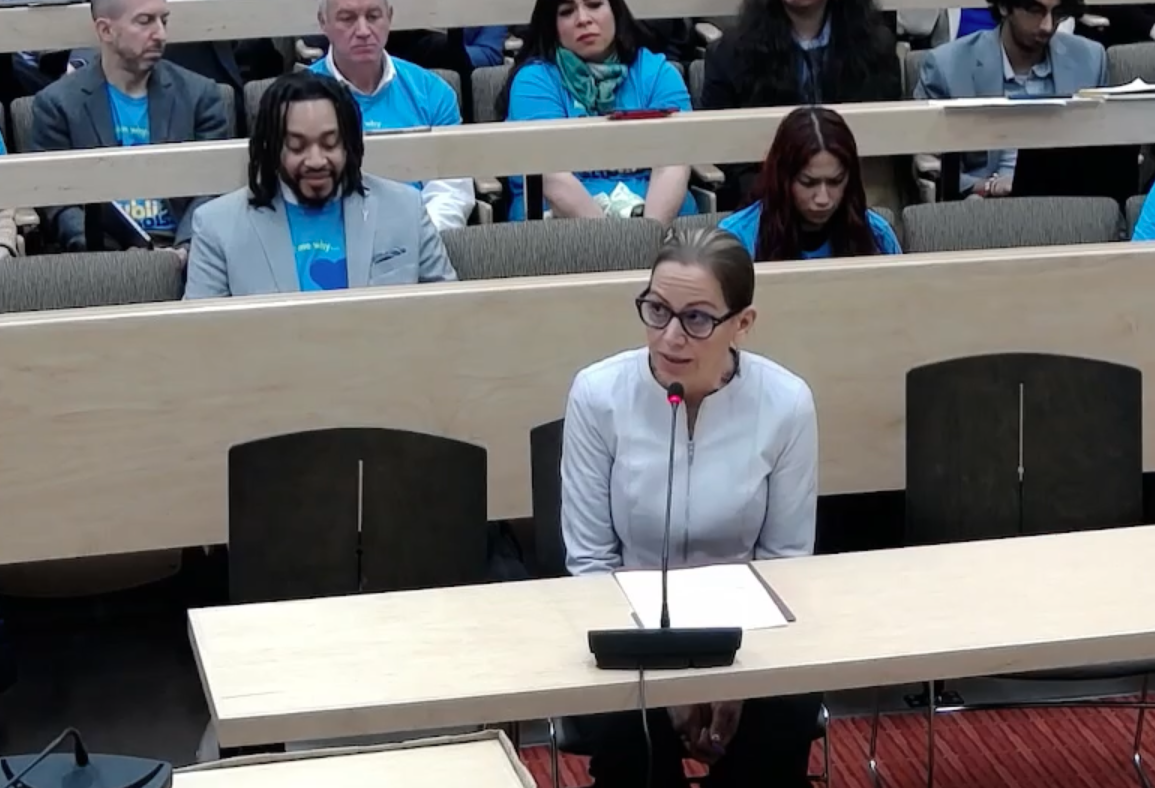
During the Nov. 12 State House hearing, some education reform advocates spoke out against the Trust Act. Mary Tamer, who heads Mass Potential, said the modifications to state interventions in the Trust Act would be “disastrous for families and children.”
She added, “Without question, the process of receivership in Massachusetts has had its successes and shortcomings but removing the state’s ability to classify schools based on their performance and the ability to prescribe remedies, including leadership that comes from outside the district, is not a win for the commonwealth’s families.”
Ed Lambert, executive director of the Business Alliance for Education, also spoke against the Trust Act’s approach.
“Senate bill 374 would represent another step in the erosion of high standards, high expectations and accountability, accelerating our march toward further inequity,” he said.
Addressing Lambert, state Sen. Jason Lewis, who presided over the Nov. 12 hearing, said he agrees with the Trust Act’s push to redefine how schools and school district performance are measured and questioned the efficacy of state interventions, citing the years-long receivership in Holyoke.
“On the most recent calculation, Holyoke was dead last,” he said. “How do you explain that?” Lambert admitted receivership has had “mixed results.” Lewis then urged Lambert “to work with other stakeholders… rather than defend the status quo.”
Most charter school supporters who attended the hearing voiced opposition to a provision in the Thrive Act that would eliminate the doubling of the statewide cap on charter schools in districts ranked in the bottom 10 percent in school performance.
While charters can claim only 9 percent of student funding in districts statewide, in the bottom 10 percent of districts, they can claim up to 18 percent of per-pupil funding. Because the expansion of charters comes at the expense of the budgets of the districts in which they operate, critics of charters claim they undermine traditional schools.
Tang, whose union represents both public school and charter teachers, suggested the AFTM might be willing to negotiate on that portion of the Trust Act.
“We do think there needs to be a solution to this, but we don’t want it to be divisive and we don’t want it to cause any harm to any school or any student,” she said.
Sen. Gomez said in an emailed statement that he’s open to modifying the legislation. “We believe that part of the legislation deserves a closer look, and we’re open to that conversation,” he said in the statement. “Our focus is, and always has been, on dismantling a punitive system that has failed our students and replacing it with one that lifts them up. That’s the work we’re committed to.”
This article was originally published in the Dorchester Reporter


