


School districts struggling with loss of students, state funding
As the Trump administration seeks to deport immigrants at an unprecedented rate, Massachusetts school districts are facing the loss of millions more in state funding that is tied to enrollment figures.

School districts across the state have for several years struggled with a state Chapter 70 school funding formula that hasn’t kept pace with inflation, leading to multi-million-dollar deficits. Now, as the Trump administration seeks to deport immigrants at an unprecedented rate, many of those same districts are facing the loss of millions more in state funding that is tied to enrollment figures.
“There is a level of fear that is hard to quantify but impossible to ignore,” said Lynn School Superintendent Molly Cohen. “It shows up in our attendance patterns, it shows up in families who quietly withdraw students, it shows up in increased community stress.”
Between January 2025 and January 2026, Lynn
Public Schools lost 600 students, many of whom are thought to have withdrawn from school to avoid ICE agents who have sought to seize students and parents as they arrive at or leave school buildings.
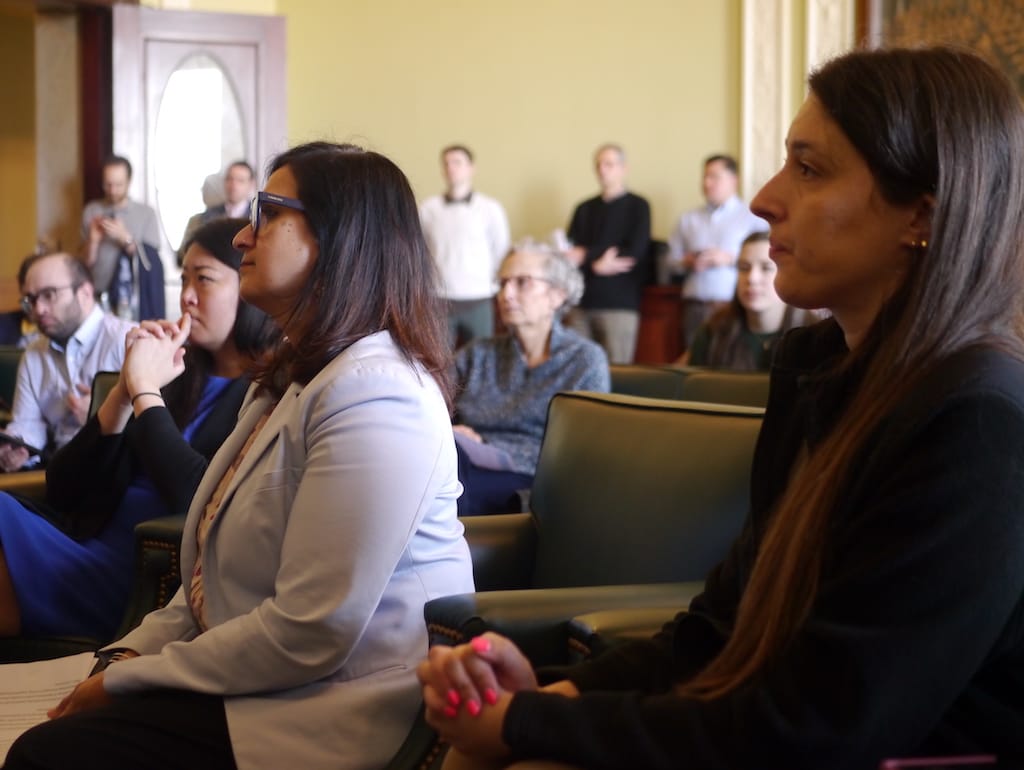
Last Wednesday, Cohen and other school leaders, teachers, and union officials gathered at the State House to outline the challenges facing school districts with high numbers of immigrant students.
School officials and parent activists are calling on lawmakers to draw from the $3 billion in revenue raised by the Fair Share Amendment, a ballot referendum that placed a surtax on personal income above $1 million in Massachusetts, for additional funding for local schools.
“When pandemic-related enrollment drops threatened school budgets, the state stepped up to full in the gap,” said Framingham parent Meenakshi Agarwal.
“The Legislature has the opportunity and the obligation, frankly, to do the same now.”
Enrollment declines have hit districts across the commonwealth, but have been concentrated in cities, where immigrant families are more likely to enroll children in schools. In Boston, the schools have lost roughly 3,000 students over the last two years, noted Boston Teachers Union President Erik Berg.
“It’s not really possible for Massachusetts municipalities to make up this sudden, precipitous drop in enrollment and funding from one year to the next,” he said.
“We have funding from the Fair Share Amendment and we’re asking the state to step up in the same way that they did during Covid and do what’s right and help our municipalities and school districts cushion that blow.
“Kids are going to come back, and we don’t want to set up our school districts for another surprise. Who knows what’s going to happen with the federal government these days. We need to be ready to meet the needs of our students.”
Increases allowed under Chapter 70 are capped at 4.5 percent a year under state law. But with inflation surging past that mark in recent years, school districts such as Chelsea, which last year depended on state funding for 75 percent of its $150 million school budget, are facing difficult decisions around staff cuts and school building closures.
In Boston, where more than 90 percent of the school budget is funded locally, loss of state funding combined with federal cuts will still have far-reaching impacts, said Superintendent Mary Skipper in an interview Monday morning.
“What we’ve seen is that many of our partners that provide us services have been impacted,” she said. “For instance, there was a very large behavioral health grant that came through one of our universities that was dismantled. That was a way we had behavioral interns in our schools supporting staff.”
Other external partnerships that have lost funding include UMass Boston’s pre-college and college readiness programs, state Career Connections programs, and programs run through the Private Industry Council.
While Boston benefits from a strong tax base, most cities in Massachusetts like Chelsea depend on their state Chapter 70 allocation for the majority of school funding.
Because those funds are allotted to districts on a per-pupil basis, each student who leaves a school system takes with him or her a portion of the state funding.
In Chelsea, under-funding due to the 4.5% cap has taken an $8 million bite from the budget which, this year, will be compounded by a $6 million cut due to declining enrollment, said School Committee member Sarah Neville.
“We are, I think, in the last year of a student opportunity act implementation,” she said. “These seven years are supposed to be the years where every year districts like ours get an influx of new money from the state to help us build new programs, hire more educators, close that education inequality gap to make it so that our schools are just as well-resourced as the wealthy cities in the commonwealth.
“But then, last night, we had a school committee meeting in a packed auditorium where we had to tell teachers and educators how we’re making $11 million worth of budget cuts.”
In Lynn, the decline in student enrollment is hitting particularly hard this year, according to Superintendent Cohen.
“This morning, I looked at our February [enrollment] numbers and they are continuing to drop — a 4 % drop,” she said. “With that comes a corresponding decrease in state funding. Even with drastic cuts to our curriculum, materials and contracts, we are looking at a gap of more than $7 million as we prepare to present a proposal for the fiscal year ’27 budget to the school committee next week.”
Stress local officials are feeling over the budget is compounded by ICE agents who have in the past used school parking lots and other public property as staging grounds for raids.
Last year, as ICE agents detained a local business owner with no criminal record across the street from a Lynn elementary school during morning drop off, school staff hustled to get children inside the school, Cohen said, noting that “it was clearly a traumatic event for all students.”
In Framingham, the loss of 700 students will result in a budget cut of $9 million, according to Agarwal, a co-founder of Framingham Families for Racial Equity in Education.
“The last month and a half have been devastating,” she said. “It’s been filled with educating community members, bringing our kids to meetings, testifying to save critical programs like DEI, special education, ESL and other vulnerable positions which are the always the first to be cut.”
This story was originally published in the Dorchester Reporter.


