


Volunteers submit signatures for rent control measure
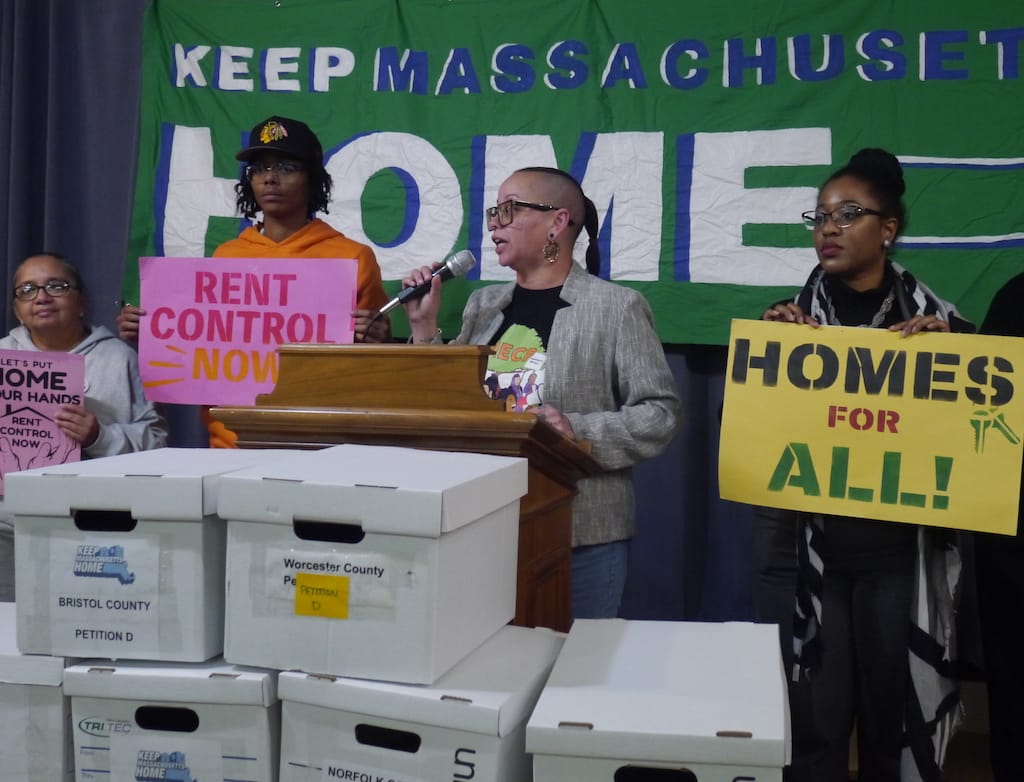
Supporters of a ballot question that would institute rent control statewide submitted 124,000 signatures to the Secretary of State Bill Galvin Tuesday, surpassing the required 74,574 needed to secure a spot on the 2026 ballot.

Supporters of a ballot question that would institute rent control statewide submitted 124,000 signatures to the Secretary of State Bill Galvin Tuesday, surpassing the required 74,574 needed to secure a spot on the 2026 ballot.
The coalition of community organizations and advocacy groups say they collected signatures in 332 of the state’s 351 cities and towns, deploying hundreds of volunteers across the state.
“We touched every corner of the state, collected signatures in every county of the state,” said Carolyn Chou, Executive Director of Homes for All. “And that was one-by-one, shift-by shift, supermarket-by-supermarket. Every time we talked to someone, they were ready to sign. This resonates with communities across the state.”
Chou and representatives from other community-based organizations that participated in the signature collection gathered at the Bowdoin Street Church on the Hill before a contingent marched 10 boxes of signature sheets over to Galvin’s One Ashburton Place office.
The ballot measure, which would cap rent increases to no more than 5% a year, with exemptions for owner occupied buildings with no more than four units. Under the measure, a landlord renting an apartment for $2,000 a month would be limited to raising the rent to no more than $2,100 in a one-year period.
The measure comes after years of advocacy from activists and local elected officials. Rent control was banned in Massachusetts 31 years ago after property owners won a statewide ballot referendum. As rents in cities and towns across the state have surged in recent decades, activists have repeated pressed the legislature to allow the return of rent control.
In 2023, Mayor Michelle Wu sought passage of a home rule petition that would allow Boston to cap rent increases at no more than 10% a year, but the measure died in the State House. Lawmakers last year refused to act on legislation that would have given individual cities and towns the option to institute rent control.
Activists who gathered on Beacon Hill Tuesday said the Legislature has left them no choice but to take the measure to the ballot.
“For far too long, we have been waiting for the state legislature to step up to the plate and pass our legislation,” said Mimi Ramos, executive director of the New England Community Organizing Project. “We have had three legislative cycles where the commonwealth just was not ready. We’re thankful for the elected officials that did step up, that did sign in support of our bill, but our communities can’t wait anymore.”
A Suffolk University/Boston Globe poll of registered voters released Nov. 25 found that 62.6% would support the rent control ballot question.
The signatures are due at the Office of the Secretary of State by the first Wednesday in December. After that office certifies that the petition has met the threshold of 74,574 signatures from registered voters, the petition is forwarded to the Legislature in January. Lawmakers can pass the legislation, propose a substitute law or take no action, in which case the petitioners must collect another 14,429 signatures in order for the measure to appear on the November ballot.
This year 10 referenda are expected to appear on the ballot — the largest number of questions since the 2000 election.


