


City taps few minority contractors for White Stadium project
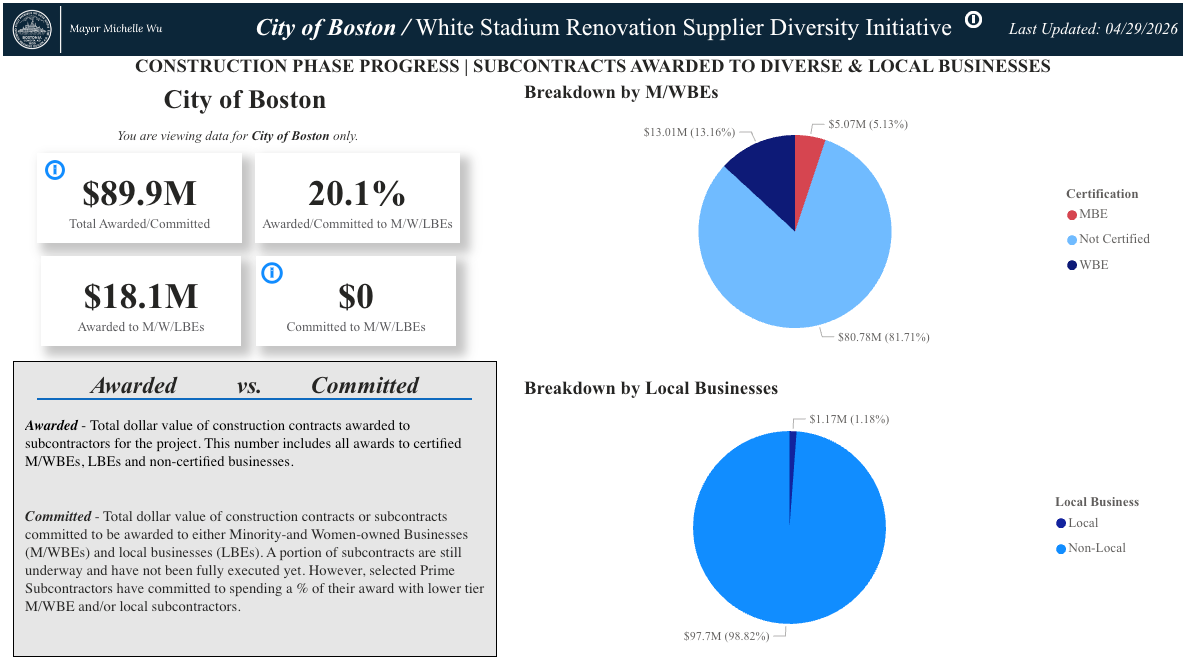
Minority-owned businesses have gotten just 5.13% of the more than $89 million the city has spent so far on its portion of the project.

In February 2026, when Mayor Michelle Wu announced the $135 million price tag for the city’s share of the White Stadium project, she touted $43 million in contracts awarded and committed to minority and women-owned businesses so far on the project.
But a closer look at the numbers seem to put that in doubt.
On the city’s White Stadium Supplier Diversity Initiative website, the breakdown between the city’s portion of the project and that undertaken by Boston Unity Soccer Partners (BUSP) shows far fewer minority-owned businesses getting a piece of the city’s portion of the project.
Minority-owned businesses have gotten just 5.13% of the more than $89 million the city has spent so far on its portion of the project, according to the city’s White Stadium Supplier Diversity Initiative dashboard.
City Councilor Brian Worrell, who has reviewed the city’s White Stadium contracts with minority business enterprises, says the Wu administration could have adopted the so-called Massport model, through which state officials evaluated bidders for construction and design contracts based on their commitments to meeting diversity and inclusion goals.
“What we have learned is that there was no real intention to follow the Massport model,” he said. “There was no program set up, knowing that barriers to minority contractors would present themselves. It was doomed to fail from the start.”
A spokesperson for the city did not directly answer questions emailed from the Reporter, but issued the following statement:
“The newly renovated White Stadium represents the largest community benefits investment in Boston’s history,” the statement reads. “With construction underway, this historic project is already driving local economic development and creating opportunities for our local businesses. We’ll continue to work alongside community members and our White Stadium Supplier Diversity Advisory Group to ensure that our local minority- and women-owned small businesses are connected to opportunities at every stage of the project.”
During a February press conference, Mayor Wu characterized the $190 million the BUSP plans to spend building out its portion of the project as a community benefit, with those monies being used to build out a beer garden, locker rooms for the team, a grandstand and luxury viewing boxes that overlook the stadium. Boston Public School (BPS) students and community members will be able to use the stadium most of the time, although BUSP will have exclusive use on 20 scheduled game days. Football will not be allowed in the stadium during the soccer season, which extends into November.
While city officials maintain that one-third of the total contracts awarded on the project have gone to minority and women-owned businesses, that figure includes the BUSP portion of the project and lumps minority business enterprises (MBEs) in with women-owned businesses.
BUSP has set a goal of 50% of all contracts on its portion of the project — projected to cost $190 million — going to M/WBEs. At the outset, the city appeared to aim far lower, setting a goal of 17% minority and women-owned business participation in its portion of the project. On the city’s website, which was last updated April 29, women-owned business participation is at 13.1%. Boston-based businesses account for just 1.1 percent of the contracts awarded so far, with roughly two-thirds of the $135 million total the city intends to spend already awarded.
“These numbers point to exactly what residents have been warning about for the last two years,” said at-large Councilor Julia Mejia. “Our office, the NAACP, Franklin Park Defenders and community advocates have consistently raised concerns that the White Stadium project was never truly centered on Boston residents or Black and brown communities. Now the city’s own numbers prove it.”
Of the $64 million BUSP has spent so far, 20.4 percent has gone to minority-owned businesses, 13.8% has gone to women-owned businesses and 18.8 percent has gone to locally owned businesses.
District 7 Councilor Miniard Culpepper attributes the disparity between the city and BUSP’s numbers to ordinances that mandate that the city use union-affiliated contractors. Because Blacks, Latinos and Asians have long been under-represented in the Boston-area building trade unions, it’s more difficult for the city to meet those numbers, he said.
“What we’ve been really focusing on is the [BUSP] numbers,” he said. “I’m not disappointed with their numbers.”
Culpepper filed an ordinance to create a Minority Business Enterprise Procurement Readiness Pilot Program to provide local contractors with a capacity building program aimed at enabling them to bid on large city contracts. It’s unclear whether such an initiative could be deployed in time to allow local businesses to bid on portions of the ongoing $325 million White Stadium construction project.
“Too often, MWBEs are shut out before they even get a chance, lacking the capital, technical capacity, certifications, or union affiliations just to be eligible,” Culpepper said in a statement emailed to the Reporter. “That is not a failure of local businesses. That is a failure of the city to invest in them.”
But Worrell says the city could be doing better now, citing the Massport-controlled project that produced the Seaport’s Omni Hotel, a project on which Black-owned Janey Construction served as a general contractor in a joint venture with Turner Construction, also a Black-owned firm.
“This is 2026,” he said. “We have the Kroc Center as a model. We have Massport and the Franklin Cummings Tech building as a model. We chose not to follow them. It has been a missed opportunity so far.”
The article was originally published in the Dorchester Reporter.


