


Brookline residents want town to stop sharing info. with ICE
For years, police officers in the Town of Brookline have shared information on arrests, protests and public safety threats with federal officials through the Boston Regional Intelligence Center.

For years, police officers in the Town of Brookline have shared information on arrests, protests and public safety threats with federal officials through the Boston Regional Intelligence Center (BRIC) — a federally funded fusion center in which local police from nine municipalities work directly with federal agents.
Now, as the FBI and other federal agencies are sharing intelligence with the Department of Immigration and Customs Enforcement (ICE), a group of Brookline’s Town Meeting members are calling on their police and fire departments to withdraw from the BRIC, refuse associated federal funding that requires information sharing and stop uploading fingerprints for non-felony offenses to federal databases.
The call for withdrawal from the BRIC became more urgent last week, when a Framingham immigrant who was arrested in Brookline for riding a motorcycle with an invalid license plate, dropping his motorbike on a police officer’s foot and then fleeing was booked and fingerprinted, then promptly arrested by ICE agents after he was released on bail from police custody.
“We know people who are being booked are having their due process rights and civil rights stepped on by a rogue federal agency,” said Town Meeting member Alec Lebovitz. “Each of these abductions that have happened in Brookline have been facilitated by fingerprinting.”
Lebovitz signed on to town meeting warrant item 25, a resolution requesting the discontinuance of state and local collaboration with Federal Immigration Enforcement and participation in related information-sharing programs, which proposes to end Brookline’s participation in the BRIC. He also signed on to warrant item 17, which would codify in the town’s bylaws the town’s February executive order which bars federal immigration officials using town property to stage immigration raids and from executing searches for individuals in public spaces without a judicial warrant.
Backers of town meeting warrant articles 17 and 25 say the flow of information between local police and federal immigration agents that is facilitated through the BRIC goes against the town’s stated opposition to ICE’s actions.
“Police are sharing unsubstantiated allegations with ICE, which leads to increasing arrests and deportations,” said Brookline resident Sarah Sherman Stokes. “It also comes at the expense of our privacy and free speech.”
Local police departments, including Boston, have shared information with federal authorities on nonviolent protests, including the Occupy Wallstreet movement, Black Lives Matter protests and pro-Palestinian demonstrations, Stokes noted. Boston’s police department’s controversial gang database is also hosted at the BRIC. Teenagers and young adults are added to the database based on police officers’ and informants’ assertions of their involvement with or even adjacency to gangs.
The Boston police definition of a gang is a group of three or more individuals who associate with each other, at least one of whom has engaged in criminal activity. Under that broad definition, thousands of teens and young adults, the vast majority of them Black and Latino, have been added to the database. For immigrants, inclusion in the database is widely seen as a decisive factor in immigration court.
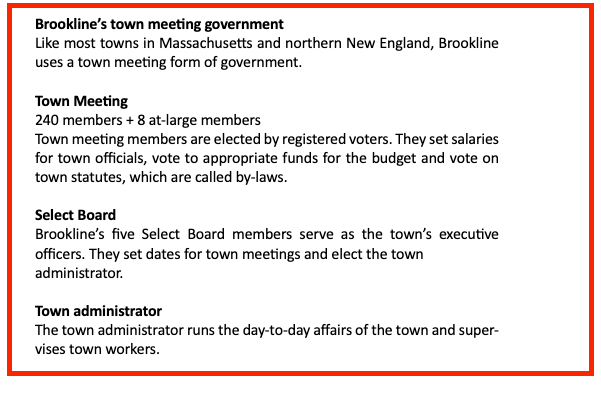
The Town Meeting members backing warrant items 17 and 25 have met with opposition from Brookline Police Superintendent Jennifer Paster, who argues that the town needs the funding it receives through the BRIC and its participation in Urban Areas Security Initiative grants. Paster is out of the office until next Tuesday and department spokesman Sgt. Russel O’Neil did not respond to a request for comment for this story.
Select Board President David Perlman said the five-member body will support the recommendations of Superintendent Paster.
“The chief of police believes Brookline benefits from being in the BRIC,” Perlman said.
Perlman said two Select Board members are working with Libovitz and other Town Meeting members to compromise on the warrant articles.
Town Meeting member Chi Chi Wu, who is backing the warrant items to withdraw from BRIC and bar ICE from activities on town property, says much of the opposition may boil down to funding.
Through the town’s participation in BRIC, Brookline’s police and fire departments receive a portion of $22.2 million in the Urban Area Security Initiative funding that supports the fusion center. The town — which passed a Proposition 2½ override May 5 raising property taxes to stave off budget cuts — may be depending on its share of the funding for its public safety budget
But Wu said opposition to warrant item 17 wouldn’t cost Brookline anything.
“We were surprised by the level of opposition to our warrant article that simply converts the Select Board proclamation into a bylaw,” she said. “We’re puzzled by why the police department still continues to oppose it.”
Federal funds aside, Sherman Stokes says she doesn’t believe the town’s participation in the BRIC makes it any safer.
“Newton is not in it,” she said of Brookline’s neighbor to the west. “Newton is no less safe than Brookline.”


