

Coalition aims to bring private school vouchers to Mass.
A coalition of education reform groups is seeking to bring a federal tax credit voucher program to Massachusetts.

Last November, Florida’s Auditor General found that the nonprofit managing the state’s school voucher program mismanaged millions of dollars and had “myriad accountability challenges.”
Last week, a coalition of education reform groups, Catholic and Jewish schools and other organizations serving children seeking to bring a federal tax credit program modeled after Florida’s to Massachusetts gathered at the John F. Kennedy Presidential Library and Museum.
“Covid relief money is gone, inflation is bad, buses are expensive, special education is expensive,” former Massachusetts Education Commissioner Jeff Riley told an audience of about 200 that filled an auditorium at the museum last Wednesday. “We have an opportunity for this new pot of money to help us with things like expanded learning time, high dosage tutoring, special education services. This seems like a time when people should get together.”
The Education Freedom Tax Credit program Riley was referring to is part of the so-called One Big Beautiful Bill, which President Trump signed into law on July 4, 2025. It would provide a tax credit of up to $1,700 for individuals who donate to nonprofit organizations that distribute scholarship funds to private schools, after school programs and other education-related services.
Governors must opt into the program in order for private schools and other educational entities to receive funding through the tax credit program and the local coalition, which calls itself the Massachusetts Educational Opportunities Coalition, may face an uphill battle. So far, while 30 Republican governors have opted into the program, just one Democratic governor, Jared Polis of Colorado, has done so.
Gov. Healey has not yet weighed in on whether she will opt Massachusetts into the federal program. While she will likely face pressure from the Massachusetts Educational Opportunities Coalition to opt in, Healey is also facing pressure from the Massachusetts Teachers Association and the Massachusetts chapter of the American Federation of Teachers (AFT) to reject the tax credit.
“Overall, across the country, voucher programs have resulted in more inequality for the students who need the most and disproportionately benefitted parents who already send their kids to private schools and can afford them,” said Jessica Tang, president of AFT Massachusetts.
Public opinion may also be a challenge. According to polling from the pro-charter school group National Parent’s Union (NPU), a majority of parents oppose vouchers for private schools, noted the group’s lobbyist, Ariel Taylor Smith. During last Wednesday’s meeting, Smith counseled the activists to stress the voucher program’s benefits for public school students such as after school programs, high impact tutoring and services for students with special needs.
“The bottom line is simple,” she said. “When this works for public school families, parents overwhelmingly support it.”
The Trump administration’s advancement of a national voucher program comes at a time when his administration seeks to slash federal education funding, as outlined in Project 2025 — the blueprint for the president’s second term in office drafted by the conservative Heritage Foundation, an organization that has long backed private school vouchers.
“As soon as you normalize the idea of sending public dollars to private institutions, then you’re opening the door to vouchers,” said Jack Schneider, director of the Center for Education Policy at UMass Amherst.
Under the provisions of the Education Freedom Tax Credit program, tax payers would make donations to so-called scholarship granting organizations (SGOs), which then distribute funding to education providers. The scholarship funds distributed by the SGOs are available for students in families making up to 300% of an area’s median income. In the greater Boston area, that limit would mean a family of three could make up to $446,700 and qualify for a scholarship funded by the program. The SGO would keep 10% of the federal funding for administrative costs.
Schneider said the program’s use of nonprofit SGOs would effectively “money launder” federal funding to private institutions, including for-profit entities.
“It’s a way of obfuscating,” he said.
The National Parents Union is spearheading the local coalition which aims to pressure Gov. Maura Healey to adopt the tax credit program. So far, the group counts 124 organizations in support, including The Pioneer Institute, The Boston Foundation, the Lynch Foundation, 45 individual Catholic Schools, 18 Montessori Schools, 13 Jewish day schools, the umbrella organizations supporting those types of schools and dozens of YMCAs and Boys and Girls Clubs.
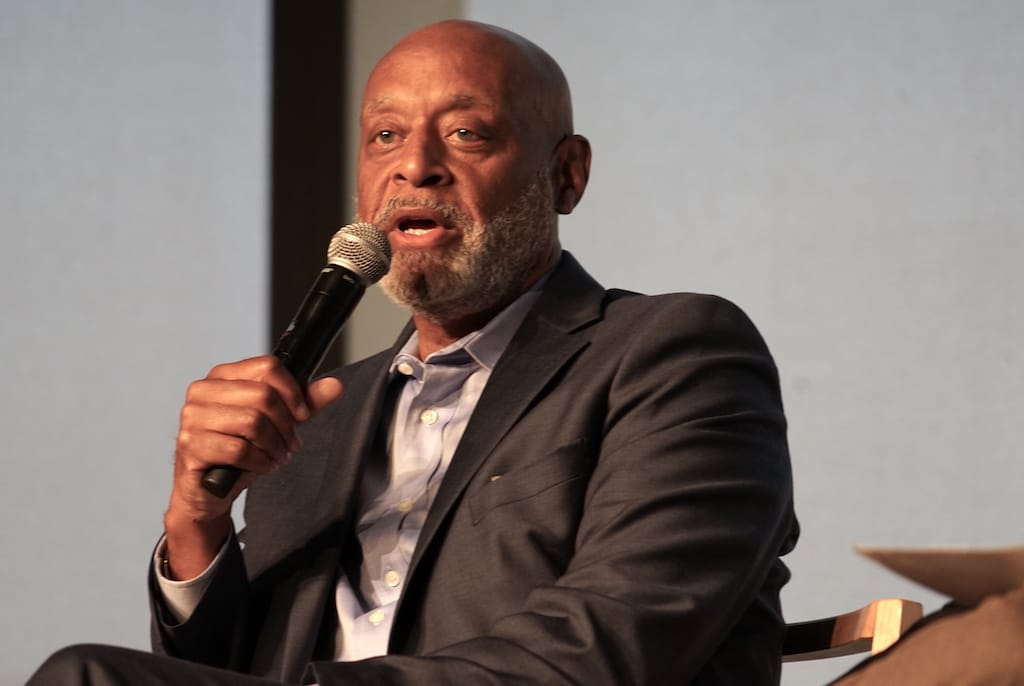
At the meeting Wednesday, which served as a sort of Coalition launch, former Education Commissioner Riley joined Democrats for Education Reform founder Kevin Chavous and Nicholas Hernandez, founder of the Colorado-based group Transform Education Now, for a panel discussion on the local effort to bring the tax credit to Massachusetts.
Florida’s SGO, Step Up for Children and SGOs in Arizona, which has a similar program, have come under fire for financial impropriety, as Chavous mentioned in his remarks.
“They've had some challenges because, again, if you pick the wrong SGO leadership, then, you know, luxury cars were bought and all this kind of stuff,” he said.
Arizona Governor Katie Hobbs, a Democrat, last Monday vetoed a bill championed by Republicans in that state’s legislature that would have opted the state into the federal voucher program, citing what she said is an absence of accountability measures in the legislation.
“We have seen what happens when these types of programs lack accountability, transparency, and oversight,” she wrote in her veto letter. “I hope the administration ensures any federal school choice program will have the much-needed guardrails Arizona’s ESA program lacks.”
Arizona U.S. Sen. Mark Kelly last Wednesday filed legislation backed by 29 of his Democratic colleagues filed the Keep Public Funds in Public Schools Act, which would repeal the Trump administration’s voucher program.
“In Arizona, we’ve already seen how universal vouchers are leading to rampant fraud and benefitting people who already had the means to send their kids to private school, while decimating public education for everyone else,” Kelly said in a press release.
NPU’s Taylor Smith said her organization expects that the Treasury Department will issue guidelines for the program by June of this year, but acknowledged the regulations would likely be inadequate in preventing fraud, waste and abuse and that states may have limited means to impose their own restrictions on the use and administration of the funds by SGOs with federal 501(c)(3) nonprofit status.
“We know the treasury will likely not regulate the quality of programming,” she said. “They are tax people. They are not education people. And there may even be some prohibitions in the final rule making from Treasury around states accepting all SGOs with a 501(c)(3) or preventing states from excluding SGOs that have a compliant 501(c)(3).”
While Democrats in Arizona and Florida have objected to the mismanagement of funds in those states, others in the party express reservations about the use of public funds for private schools.
“Our tradition is to cherish education,” said Massachusetts state Sen. Pat Jehlen of Somerville, who is vice chair of the Senate Education Committee. “That’s in the constitution. We believe in the common school as the place for people to come together and get along. The intention in Washington is to benefit private education.”


