


Immigrants fighting for justice 1 year after Allston Car Wash raid
The very public event and backlash shocked the community and one year later, the nine employees and Segal are quietly attempting to come to terms with the raid and chaos that followed.

Cooper Formica
It’s been a year since an Immigration and Customs Enforcement raid at Allston Car Wash led to nine employees being detained.
In the weeks following the incident, local and national headlines carried news of the raid alongside a post from Zac Segal, the then President of the Boston University College Republicans, falsely claiming responsibility for reporting the workers to federal officials.
The very public event and backlash shocked the community and one year later, the nine employees and Segal are quietly attempting to come to terms with the raid and chaos that followed.
Yuli Luarca was among the nine who were detained, she is an asylum seeker from Guatemala and has been in the United States for five years. One year after the raid, she has decided to talk about her experience publicly for the first time.
“At that moment, I couldn't even speak — I was completely frozen,” Luarca said, recalling the raid. “We were absolutely terrified. It happened so abruptly — they even cornered me against the side of the car to put me in handcuffs.”
The raid
Getting detained by ICE was certainly not on Luarca’s radar when she arrived at work on the morning of November 4 last year. A detailer at the car wash, Luarca was working when federal agents showed up.
Within minutes, they arrested the nine employees, without allowing any of them an opportunity to retrieve their work permits or contact their families.
“At the time, I honestly felt as though this might be the end — that we wouldn’t make it out of this country alive. We were completely caught off guard, and the situation we found ourselves in was absolutely terrifying.” Luarca said.
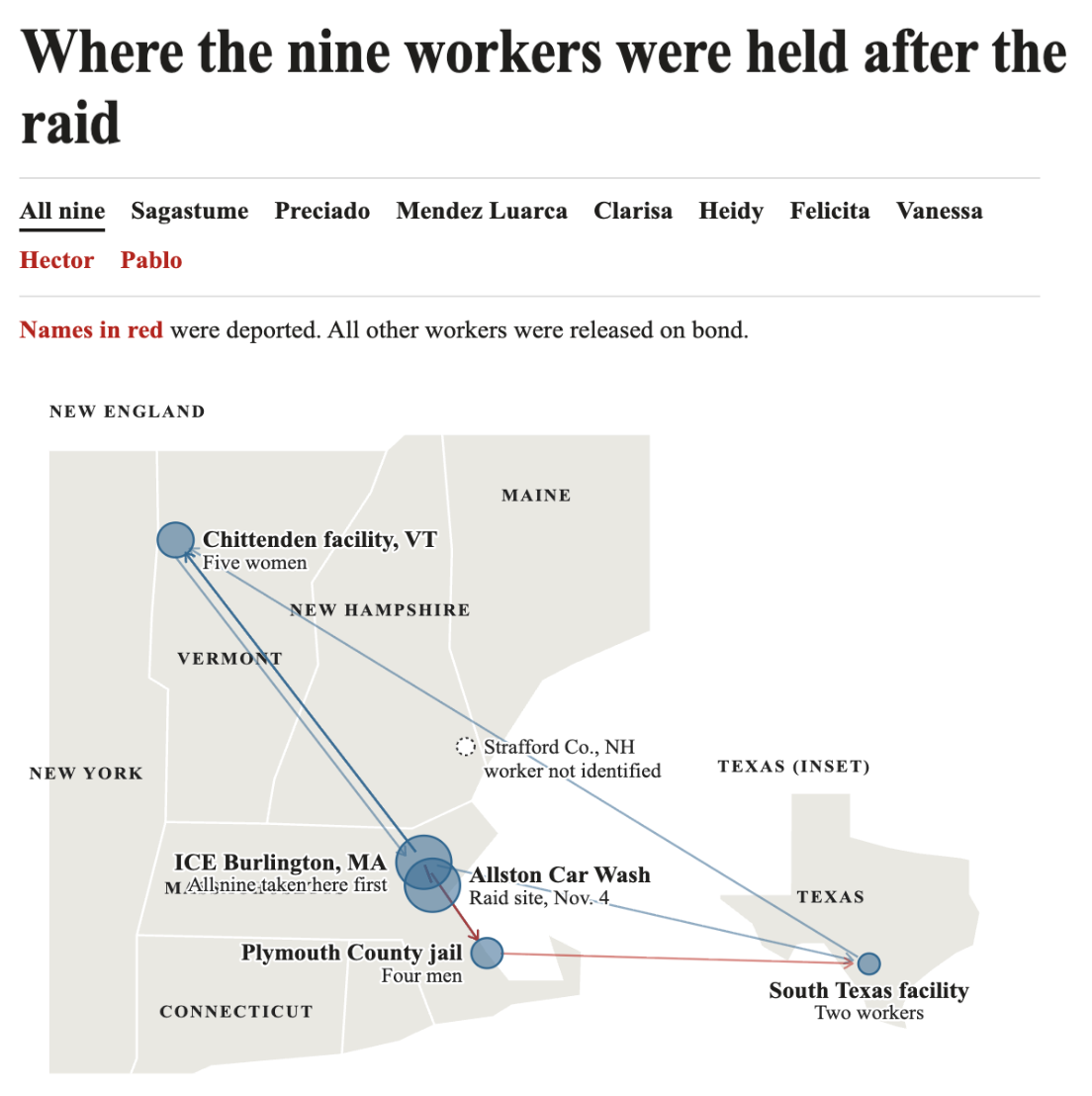
After being apprehended Luarca and the other workers were taken to a nearby Target parking lot and lined up against a wall as federal agents further restrained them using ankle chains before being processed at the ICE facility in Burlington, Mass.
Luarca says the conditions in detention were incredibly poor. For the eight days she was in the Burlington facility, she had to sleep on the floor, “with my jacket, back to back, with no mattress, nothing, just the bare floor.” she said.
She also described having limited access to food and water, all while facing pressure from federal officials to sign a voluntary deportation waiver as her case waited to be processed.
“They only let us shower almost twice in the eight days we were there.” Lucara remembered. “And canned food — food between cold and hot, no more than porridge or a little jar of mosh and water.”
In the following weeks, Luarca and the others were moved to detention centers throughout the country.
“For 15 days we didn’t know what was happening, whether they would deport us or send us somewhere else, what would happen to us,” she said.
Because the ICE Detention and Reporting Line (DRIL) was nonoperational at the time, even the U.S. attorneys processing their cases were unsure where the employees were being held, according to her attorney Todd Pomerleau.
It wasn't until Yuli’s sister and other family members of the detainees contacted Pomerleau that he and the Mass Deportation Defense were able to begin filing petitions to locate and release the employees.
After being moved to a facility in Chittenden Vermont, during the second week of her detention, Luarca was finally able to contact her sister. A few days later, she received a phone call telling her a judge had reviewed her case and ordered her release in the coming days.
“She let me know that, thank God, the judge had accepted the bail, and all that was left was to pay it that afternoon so I could wait to be notified what day I would be released.” Yuli said. “The next day — I didn't have to wait long—they released me, thank God.”
For the following month, six of the nine detained employees were located and by families and able to access legal counsel. By early December, seven of the nine employees had been released on bond, even though the release didn’t settle their immigration status.
The two who remained in custody had been given deportation orders years earlier, according to Pomerleau, but were unaware of those orders. Facing a longer detention time with no guarantee that an appeal would work in their favor, both men elected to return to their country of origin later that month.
Through reporting compiled from various news outlets, The Flipside was able to document where each of the detainees were held before being granted bond or deported.
Zac Segal
While many of the workers were still fighting for their release, the raid began to draw publicity for a different reason. Zac Segal, then-president of the Boston University College Republicans, claimed in a series of now-deleted X posts to have reported the carwash to federal immigration officials.
In a post from Nov, 7 captured by WBUR, Segal claimed he called immigration officials about the Allston Car Wash for “months on end,” before agents “finally responded to [his] request to detain these criminals." In the same post, Segal added that he’d seen American jobs “given away” to people with no right to be there.
In the days that followed, Segal’s actions drew intense backlash, including from Boston University President Melissa Gilliam. Shortly after, the Department of Homeland Security statement denying Segal’s involvement.
The Boston chapter of the Democratic Socialist of America began circulating flyers labeling Segal a “racist’ and “white supremacist,” while Segal himself received multiple online threats from fellow students and Boston residents, according to a letter from his attorney, Emily Percival.
Despite the intense scrutiny, both Luarca and the other employees didn't understand why Segal made the comments nor did they hold any anger toward him, according to Pomerleau.
“The truth is that we came to work in this country and to be good people.” Luarca said. “I hope [Segal] doesn't make that mistake again, because we are humans and we all need this country.”
Looking forward
The seven car wash employees who remain in the U.S. are continuing to work while they wait to finalize their immigration status. According to Pomerleau, they are all “deeply traumatized by the experience.” And, other than Luarca, declined to be interviewed.
They are also seeking $7 million in civil damages against the government for the emotional and psychological trauma caused by the raid and following detention, according to a civil complaint filed last April. The lawsuit is still pending.
In January, Segal’s attorneys sent a demand letter to Boston University alleging the university failed to “meaningfully deter or prevent the harassment and threats directed at him.” following his post. The letter also requested the University allow Segal to complete his coursework at the Washington, D.C. campus.
Segal is currently continuing his studies as a senior at Boston University and could not be reached for comment.
The Allston Car Wash is still operational, although Luarca has not continued to work for them since being released. A representative of the car wash also declined to comment on the story.
Luarca is still trying to work, while she waits for her asylum status to be finalized but has only been able to work seasonally because she does not have permanent status.
“Because of the same situation we find ourselves in — that we don't have papers, we don't have anything — as a result of that, we don’t have permanent work.” Luarca said.
Although she is still struggling to make sense of the events, she is grateful she was able to be released and for the community members who helped her.
“Even today when I remember it, I say God has a purpose for our lives, but meanwhile we lived a very ugly experience.” Luarca said. “It's not fair for people who come to work honorably.”


