


'The results were all over the map': Lots of challengers, few successes in primary
“This election had different narratives depending on where you were,” said Progressive Massachusetts Policy Director Jonathan Cohn.

For the 19% of Boston voters who turned out in last Tuesday’s Democratic primary election, the stakes were high: U.S. Sen. Ed Markey, U.S. Rep. Steve Lynch, three state senators and District Attorney Kevin Hayden faced primary challengers.
The results of the election were all over the map.
“This election had different narratives depending on where you were,” said Progressive Massachusetts Policy Director Jonathan Cohn.
In the Boston-based districts at play, Mayor Michelle Wu staked political capital on three Senate races, backing progressive challenges by Daniel Lander and Latoya Gayle as well as backing conservative-leaning incumbent Michael Rush against attorney and consumer advocate Persis Yu of Hyde Park. So far, Yu is the only challenger in Boston to notch a victory, ousting the ten-year incumbent in the Norfolk/Suffolk District, which included southwest Boston Neighborhoods and the suburbs.
In the Suffolk/Middlesex District, incumbent Will Brownsberger leads Daniel Lander, a senior policy advisor to Wu, by 34 votes in a race that’s headed to a recount this Wednesday.
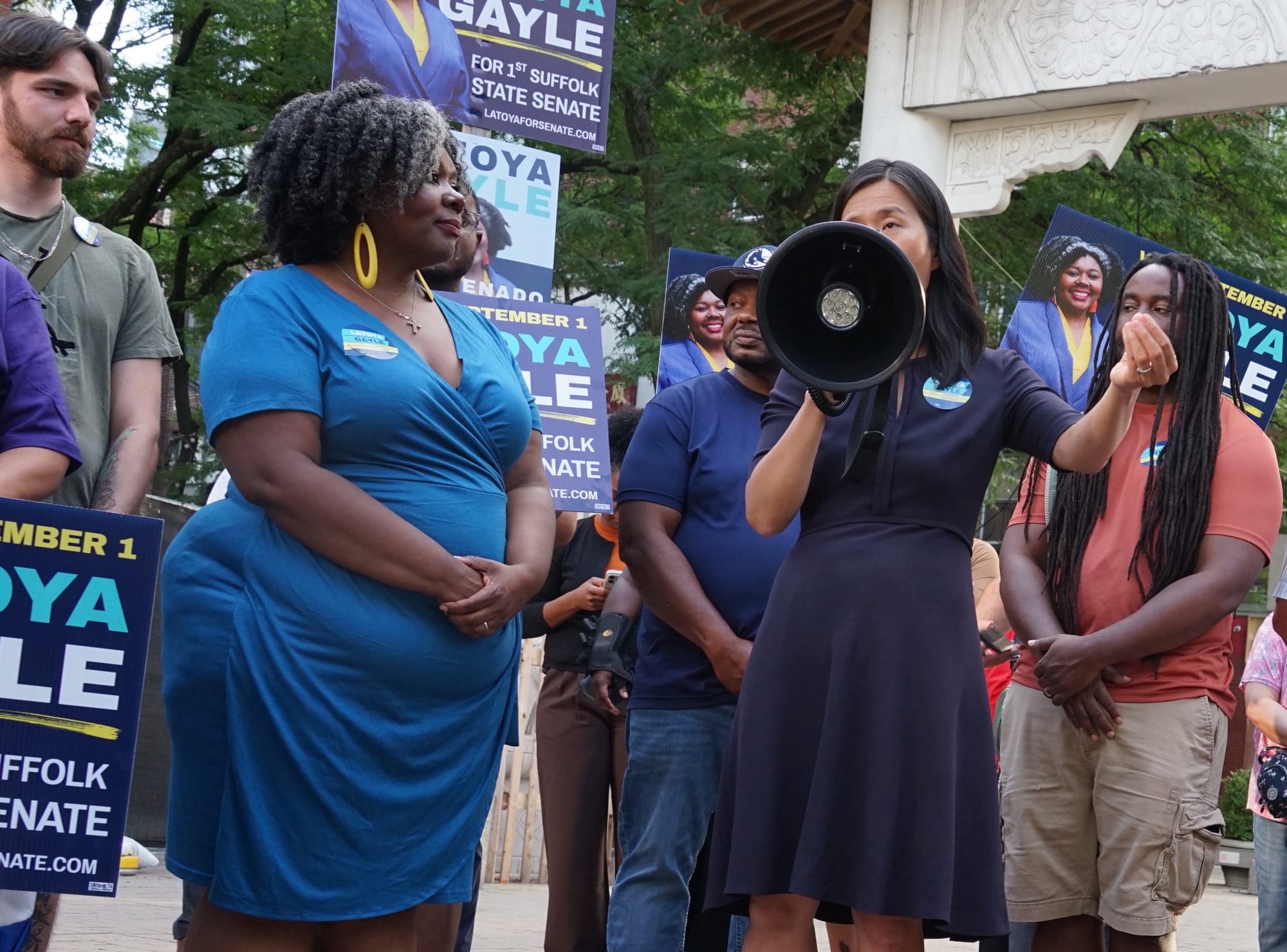
Wu notched another loss in the Dorchester/South Boston/Chinatown/South End 1st Suffolk District, backing community organizer Latoya Gayle against incumbent Nick Collins. Collins held onto his seat with 53% of the vote, more than ten points ahead of Gayle. Community organizer Juwan Skeens received 2% of the vote in that race.
While Gayle won in predominantly Black precincts in the district, turnout in the Black community was 12% — far below the city average of 19%. Collins, on the other hand, won in majority white precincts that saw turnout as high as 44%.
That same dynamic of low voter turnout played a role in the Suffolk County district attorney race in Boston, where Wu backed incumbent Kevin Hayden. Black voters showed a preference for Rollins, giving her narrow margins in the Roxbury-based Ward 12 and the Dorchester/Mattapan-based Ward 14, but she lost to Hayden in predominantly white wards and precincts elsewhere in the city. Hayden’s margin of victory in the Bay Bay/Beacon Hill/Fenway Ward 5 was 1,111 votes. In the more progressive Jamaica Plain/Roslindale Ward 19, his margin of victory was 1,333 votes.
Turnout in Ward 19 was among the highest in the city at 33% — more than twice that in wards 12 and 14 — leading to what Cohn describes as a “racially polarized result” in the primary.
The relatively high turnout in the predominantly white, liberal-leaning parts of the city — Jamaica Plain, Roslindale, Hyde Park and parts of West Roxbury — helped Persis Yu in her defeat of Rush. While Yu lost in the suburban towns in the district — Deham, Westwood, Norwood and Walpole — her 2,389-vote margin of victory in Boston more than made up for her losses outside city limits.
A political grudge
Wu’s Senate endorsements were in no small part motivated by her friction with the state Senate over taxes. Wu, the City Council and Boston’s House delegation to the Legislature favored raising taxes on commercial property in order to lower the residential rate. City revenues have trailed behind rising costs in health care and other areas. At the same time, Boston’s high commercial vacancy rate has lowered collections. Collins and Brownsberger opposed increasing commercial tax rates and blocked a home rule petition from moving forward in the Senate. Rush supported the tax shift.
Speaking to the Dorchester Reporter on the night of the primary, Collins said Wu’s gambit failed because her candidates lacked standing in the communities they sought to represent.
“I think you’re seeing the effort the mayor put forward with third parties and the fact is the candidate matters, a record matters, and you can’t just drop in a proxy,” he said. “A candidate has to be someone the community knows and trusts and has a record and will be an independent voice for the district.”
While Gayle won predominantly Black precincts in the district, her margin of victory in those precincts was not great enough to offset Collins’ victories elsewhere. In the Dorchester-based Ward 15, which includes Columbia Road, parts of Grove Hall, Bowdoin Street and Dorchester Avenue, Gayle won 50% of the vote. Collins, who benefited from endorsements from Black elected officials including reps. Brandy Fluker Reid and Christopher Worrell and City Councilor Miniard Culpepper, received 44% of the vote in the heavily Black, Cape Verdean and Latino ward.
Speaking to reporters Friday, Wu said her endorsements reflect her efforts to advocate on behalf of the city.
“I’m eager to find ways to advance the agenda on behalf of Boston residents, with whoever is in any role, in any leadership position,” she said. “But if there’s a sheer opposition to the agenda, and to changing anything, then it is our responsibility to make the most of every election cycle as well.”
Outside of Boston, Democratic Socialists of America member Rep. Erika Uyterhoeven displayed what observers said was a strong ground game to win the 2nd Middlesex Senate seat soon to be vacated by Sen. Pat Jehlen. Uyterhoeven garnered 12,397 votes in the district, which includes parts of Somerville, Cambridge and Medford, finishing with 36.9% of the vote in a five-way race, more than 6 points ahead of state Rep. Christine Barber.
In Somerville, City Councilor Will Mbah prevailed in a three-way race with 53.9% of the vote to replace Barber.
Cohn said the primary election results across Massachusetts bode well for progressives.
“There are definitely races where you could say a progressive message with a good ground game won,” he said.


