


This year's budget battles tested the City Council's authority
In the end, the councilors only succeeded in restoring funding to a handful of programs that the Wu administration had cut or zeroed out of the budget.

The City Council’s process for this year’s budget has been among the most eventful in recent years, starting with a 6-6 deadlock on whether to reject it and send it back to the mayor and including several demonstrations, one of which resulted in police removing eight protestors from the floor of the Iannella Chamber.
In the end, however, the councilors only succeeded in restoring funding to a handful of programs that the Wu administration had cut or zeroed out of the budget.
This year’s process was a far cry from the inclusive, deliberative process voters and city officials including then-Councilor Michelle Wu envisioned when they passed charter reform in 2021 granting the body the power to amend line items in the mayor’s budget.
“This process isn’t working the way it was designed to work,” said Khalil Howe, an activist with the Youth Justice Power Union. “It’s working pretty much the way it worked before charter reform.”
Howe and other activists with the Better Budget Alliance opposed the mayor’s cuts to grants and program funding for housing assistance, immigrant services, the city’s Human Rights Commission and other areas. The alliance has long advocated for cuts to the city’s policing budget and increased investments in the very areas the Wu administration cut in the budget.
The demands of the Better Budget Alliance members aren’t new. Black and Latino elected officials have been asking for a rebalancing of the city’s budget for decades, advocating for a reduction in police spending and increases in intervention programs that support local communities and prevent violence.
Yet even as violent crime rates have plummeted to levels half of what they were 20 years ago, police budgets have continued to climb, with police overtime alone expected to exceed $100 million this year. Efforts to rein in overtime spending haves so far failed. While on the campaign trail in 2021, Mayor Michelle Wu promised to cut police spending, the regular and overtime budget have increased in each year of her administration — the same year Wu and other councilors voted to change the city’s charter.
That same charter amendment that gave the Council the power to amend line items in the budget also set up the city’s Office of Participatory Budgeting, which was created to enable city residents to make decisions on public funding. While activists have sought to put $40 million of the city’s budget — just under 1% of this year’s budget — under that office, the Wu administration has put $1.2 million, or just over half a hundredth of a percent of the budget under popular control.
Activists then believed that giving citizens a say in even a small portion of the budget would help city officials better understand the needs and desires of city residents and thereby better inform their budgeting choices.
In the same vein, the Better Budget Alliance last year conducted surveys and interviews with over 700 Boston residents, primarily from Dorchester, Roxbury, Mattapan, East Boston and other predominantly Black, Latino and Asian communities. The survey found that 75% wanted to see the city’s police budget cut and funds transferred to services that directly benefit communities. Of those surveyed, 68% cited housing as a top concern, 44% health and mental health, 40% immigrant support, 30% food aid and 28% cited environmental remediation.
“As we deepened conversations with people after the survey during assemblies and working groups, people said they feel safe when they have a place to live and when they live with family members and in communities with friends,” said Better Budget Alliance member Eliza Parad. “All of the things people said helped prevent violence were these areas other than policing.”
This year, the activists’ calls for investments in communities bumped up against the challenges of revenues that have failed to keep pace with rising costs of salaries and health care. Facing a $50 million shortfall in the current fiscal year budget, the Wu administration made cuts to the very areas respondents to the Better Budget Alliance survey said they wanted funded.
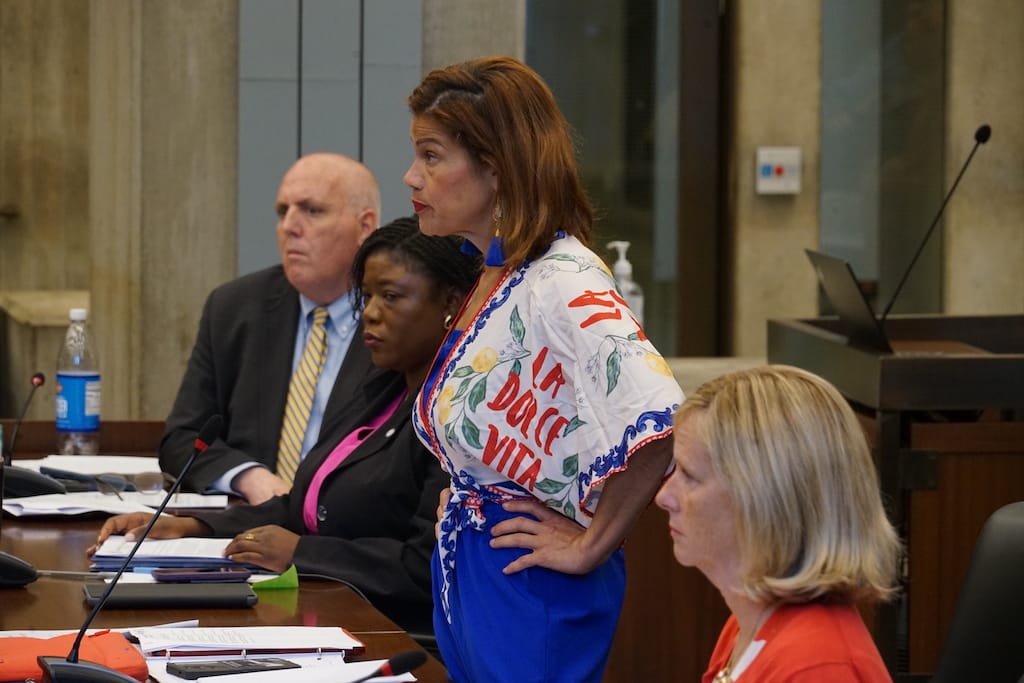
What followed was a battle on the council that revealed the fractures in a body that has frequently splits between the seven members who reliably vote with the mayor and the six who often push back on her policies and priorities. There was the 6 to 6 split on a vote to reject the budget (frequent Wu ally Gabriella Colletta-Zapata was not present for that vote). Then a series of hearings and working session during which activists protested and testified on behalf of saving programs such as the 2,000 year-round youth jobs the city has funded in recent years.
During the June 10 protest in the Iannella Chamber, during which eight protesters were arrested, a majority of the councilors were seen meeting with the mayor’s chief of Intergovernmental Relations, Ricardo Patron, in the Council offices.
Councilor Ed Flynn, who along with councilors Julia Mejia, Erin Murphy, Miniard Culpepper and Brian Worrell stayed in the chamber with the protesters, said the councilors were in violation of public meeting law.
“We can’t negotiate outside the chamber when the Council is in session,” he said. “That’s the law.”
In the end, the Council voted 12-1 to amend the budget, moving $11.8 million from areas including the Transportation Department to fund the areas Wu had cut, including housing supports, funding for the Office of Black Male Advancement and youth jobs.
Wu’s allies on the Council — a group of seven who reliably vote with the mayor on major issues such as the budget and Council presidency — ensured Wu’s budget would not be rejected. Howe and other
“This package moves more money than the Council has in recent years on a more challenging budget and with a forecast for more trouble ahead,” Ways and Means Chair Benjamin Weber told his colleagues as he introduced amendments to the budget.
The Council amended just .2% of the mayor’s budget.
This year’s budgeting process left members of the Better Budget Alliance feeling somewhat discouraged.
“I feel like it’s a case of people giving the Council the tools to do better,” said member Vikiana Petit Homme, who was among those arrested on June 10. “If the Council doesn’t want to use those tools, there’s not much we can do. I can’t say I was surprised, but it was very disappointing.”
Howe said Wu holds all the cards in the budgeting process, exercising influence over seven of the 13 councilors.
“She has allies on the Council,” he said. “She helped run their campaigns and has a lot of leverage over them.”
In an interview June 18, Wu said the budgeting process is working the way it was meant to.
“We’re now multiple years into the new budget process that was established through a charter amendment, and the way the process was set up, the administration submits a budget that is balanced and reflects the needs of our community over to the City Council, and the Council has a full window of time to analyze the budget and then pass amendments to it,” she said.
Councilor Worrell said it may be time for the Council to revisit the charter amendment that gave them the power to make line-item changes to the mayor’s budget.
“After five years with this charter amendment, we see what the Council has been able to do,” he said. “Now we have the opportunity to revisit it, to see what could put the Council in a better position to respond to the needs of residents.”


