


States would have no control over federal school voucher program under Treasury guidelines
A coalition is pushing for Gov. Maura Healey to opt into a federal school voucher program.

Under regulations the U.S. Treasury Department released Thursday for the Trump administration’s new federal voucher program, states would have no power over how money is spent and for what purpose.
Under the Federal Scholarship Tax Program, as the voucher system is called, individuals can donate up to $1,700 dollars to nonprofits and receive a full reimbursement from the IRS. Donations are made to so-called scholarship granting organizations (SGOs) which then can donate money for tuition at private and parochial schools and afterschool and summer programs. Donations can also be made to schools, including public schools, for the purchase of instructional materials.
Under the law, governors have the sole power to opt states in or out of the program.
While the Republican governors of 30 states have opted into the programs, as has the Democratic governor of Arizona, other Democratic governors have either declined to participate or said they would wait for the federal guidelines to be released.
Gov. Maura Healey has not said whether she will opt Massachusetts into the program. A spokesperson for the Executive Office of Education offered a terse statement.
“We are aware that the Trump Administration issued temporary and proposed regulations today and will review them,” the spokesperson said in a message sent to the Flipside.
Massachusetts Teachers Association President Matt Bach is part of a coalition that is urging the governor to pass on the program.
“Gov. Healey likes to stand up against Trump,” Bach told the Flipside. “This is an instance where she should. We should not re-direct public funds to private institutions.”
Vouchers have long been controversial as they’re widely seen as a way to divert public funding from public schools to private schools. The current plan, which was passed as part of the so-called One Big Beautiful Bill, marks the second time the Trump administration has proposed federal school vouchers. The administration in 2018 proposed a $1.4 billion voucher program that Congress voted down.
Last year, the Trump administration bypassed legislative opposition by adding the current voucher program to the One Big Beautiful Bill and recasting it as a tax credit.
Critics of the Federal Scholarship Tax Program say the Treasury Department guidelines offer states little to no control over how the federal funds would be spent.
“My biggest concern is that it’s very likely it disproportionately ends up sending funds to wealthy communities, communities that already have a lot of resources,” said Jon Valent, director of the Brown Center on Education Policy at the Brookings Institution.
The SGOs would be able to provide voucher money to families earning up to 300% of the area median income. In Suffolk County and parts of Norfolk, Plymouth and Essex counties, families earning up to $493,800 would be eligible. In Worcester County, the eligibility limit for families would be $391,200.
The program works in much the same way voucher programs in Arizona and Florida have worked. Individual tax payers can donate to SGOs and receive a tax rebate. In effect, the program bypasses the Department of Education and draws money for the rebates directly from the Treasury. The limit for families under the program is $3,400.
SGOs must provide funding for no fewer than 10 students and must make grants to at least two organizations. There is no cap on the amount an SGO can provide for an individual scholarship.
Theoretically, under the law an SGO could direct hundreds of donations to one school or education program and just one to another to qualify, Valent said.
“The law is so permissive, you can have SGOs set up and give really large scholarships to schools for education-related things,” Valant said.
Valent says states would not be able to rein in programs where education providers are given excessive pay or where education programs over-pay for instructional materials.
In Arizona and Florida, states that have implemented their own tax credit programs, SGOs have come under investigation for financial impropriety. Arizona, which ranks near last in public school funding, has channeled $719 million into private schools since 2022 when its Empowerment Scholarship Accounts.
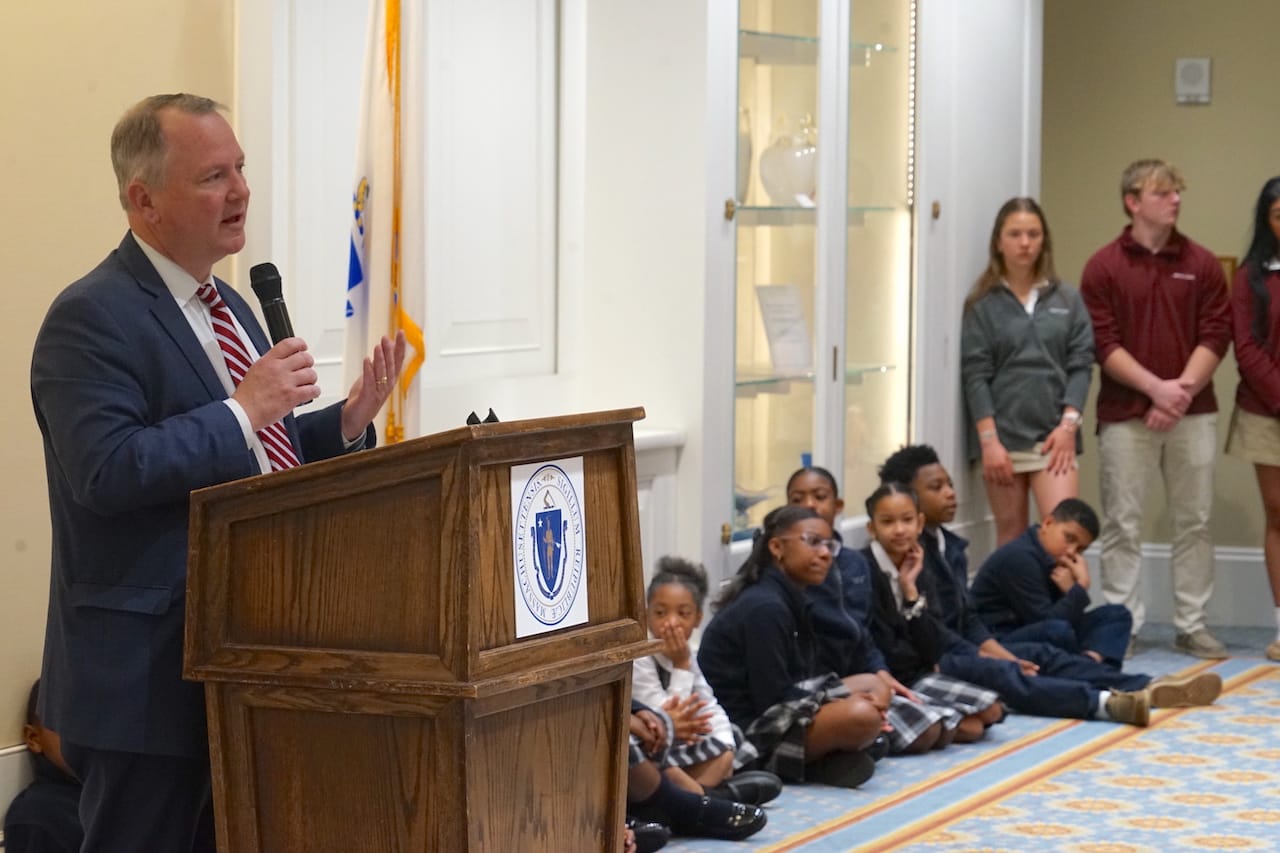
Members of the Massachusetts Educational Opportunities Coalition have argued that Massachusetts should opt into the program, arguing that to not do so would leave federal funding on the table. Speaking during the coalition’s legislative lobby day in May, former Lt. Gov Tim Murray noted that Massachusetts already pays more into the federal tax system than it receives in federal benefits.
“We contribute more than we give, which is not a bad thing,” he said. “But we are entitled to a fair share. We should seek it when appropriate.”
In states that do not opt in, taxpayers can still donate funds to SGOs in other states.
Those opposed to Massachusetts opting in argue that the federal voucher program is a slippery slope toward the privatization of education.
“It’s clearly a voucher program that’s disguised as a tax relief program,” said Matt Bach, President of the Massachusetts Teachers Association. “It’s going to take money out of the commons and put it in the hands of private institutions.”
The Massachusetts Educational Opportunities Coalition includes Catholic and Jewish day schools and their umbrella organizations, business groups and chambers of commerce and activist groups including Democrats for Education Reform, Latinos for Education, Inquilinos Boricuas en Accion, Embrace Boston and We Are ALX. Foundations, including the Boston Foundation, the Lynch Foundation and the Shah Family Foundation are also members.
Opposing vouchers are unions including the Massachusetts Teachers Association and the Massachusetts chapter of the American Federation of Teachers, as well as progressive-leaning organizations including the ACLU of Massachusetts, Citizens for Juvenile Justice, the Chelesea-based La Colaborativa, the Chinese Progressive Association, Mass VOTE and the Massachusetts Communities Action Network.
Members of that coalition are planning a rally at the State House Monday.
“These new regulations confirm what we’ve feared since the federal school voucher program was first envisioned as part of the Project 2025 agenda: It would send our public tax dollars to private schools, defunding the public schools that serve all kids while bypassing the strong local education standards that have made Massachusetts schools the best in the nation,” said coalition member Vatsady
Sivongxay, Executive Director of the Massachusetts Education Justice Alliance -
Education Fund in a press release.


