


Students, teachers slam proposal to close Charlestown, Greater Egleston high schools
Students, parents, teachers and community members from Charlestown High, Greater Egleston and the East Boston Early Learning Center are pushing back against BPS plans to shutter their schools.

When Boston Public School Superintendent Mary Skipper announced the district plans to close Charlestown High School and Greater Egleston High School, she cited a familiar set of reasons — declining enrollment, fewer students selecting the schools and, in the case of Greater Egleston, inadequate facilities.
But students, parents, teachers and community members are pushing back against the district’s narrative, alleging the BPS has its facts wrong.
Charlestown High
“In the 2025 version of the ‘Decision-Making Metrics for BPS Long-Term Facilities Planning,’ Charlestown was the 5th most chosen school at the 7th grade level, less popular only than the exam schools and East Boston High,” members of the group Quality Education for Every Student wrote in a statement released to news media. “When BPS changed the methodology just prior to announcing the school’s closure, Charlestown suddenly looked like the least popular choice among families.”
Quest members say BPS switched from factoring in the number of students currently enrolled in a school who selected the school as their first choice to excluding that metric.
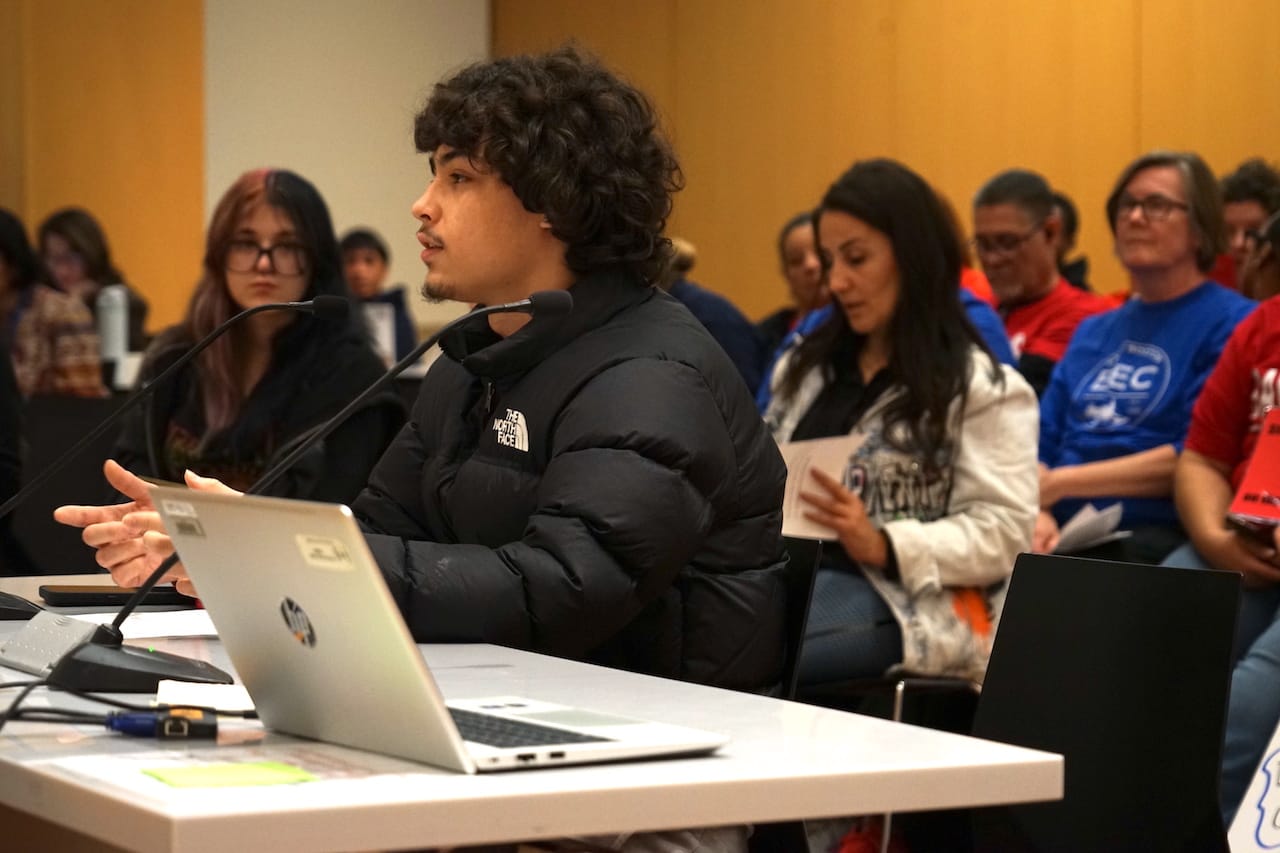
Students who testified during the Nov. 4 School Committee meeting said they valued the school’s commitment to teaching a broad range of students.
“When you look at Charlestown High on paper, it’s easy to assume that it’s not a good school just because we have low enrollment rates,” said student Tina Lee. “But what you see on paper does not capture what happens in our classrooms every day. It does not show the countless hours teachers are willing to sacrifice to support their students.”
Charlestown High School has long specialized in teaching students with disabilities and students learning English as a second language. As the population of general education students has declined — from 558 in 2023 to 305 this year, the population of special needs students has remained relatively stable — 262 in’23 and 254 this year.
“This has created a tipping point at Charlestown High School that makes it challenging to offer inclusive education opportunities,” Superintendent Skipper told the School Committee during the Nov. 4 meeting.
The changed ratio puts the school at odds with state Department of Elementary and Secondary Education guidelines that stipulate that special needs students be educated in the “least restrictive environment.” State officials expect that special needs students should be educated in general education classrooms whenever possible.
Skipper told the School Committee the decision to close schools are always difficult to hear.
“These are the hardest decisions I make as a superintendent and you make as School Committee members,” she said.
She noted that enrollment in BPS schools has declined by 21% over the last decade as birth rates have declined nationwide and the Trump administration has restricted immigration to the U.S. The school closures, along with ongoing mergers of other schools, will help BPS weather difficult financial times, she said.
“These reductions, grade reconfigurations and relocations will consolidate resources, create increased opportunities to support our students overall,” she said.
Under the district’s plan, another BPS high school will move into the Charlestown High building after the school closes.
Cecil Carey, who teaches at Charlestown, said the district should consider a merger with another high school.
“They’re sending a message to our students that they aren’t worthy of the building,” he told the Flipside. “A merger is a much better option. We don’t know why they want to throw away all the good work at Charlestown High.”
Carey said students with special needs fare far worse during school closures than students in general education programs, noting that 15% of the special needs students at West Roxbury High School dropped out of BPS after that school closed in 2018.
Greater Egleston
BPS officials cited a number of factors in the decision to close Greater Egleston High School, an alternative high school on School Street in Egleston Square, including declining enrollment at alternative high schools, an increased ability of other high schools to serve students who don’t thrive in other high schools, a low score on the district’s “Building Experience” metric.
Greater Egleston teachers and parents released a report last week picking apart the district’s assertions about their school, noting that enrollment at the school has increased from 67 students in November last year to 76 in October of this year.
Students enrolled at Greater Egleston typically arrive there after struggling at larger schools, noted teacher Jess Madden-Fuoco.
“The district does not value small schools,” she told the Flipside. “But that’s in stark contrast to how the students and families feel.”
At the School Committee meeting, Madden-Fuoco urged the committee members to visit the school and talk to the students who have chosen the school.
While Greater Egleston does not have a gymnasium, which impacts its Building Experience score, Madden-Fuoco notes that it’s the most southwestern general enrollment high school in the city, making it accessible to students in the Mattapan, Roslindale and Hyde Park neighborhoods where many of the district’s children live.
The report released by Greater Egleston teachers questions the district’s move to close the school, in spite of its increased enrollment.
“Why is BPS closing the alternative education school that has met its enrollment target for this school year and is trending positively in terms of enrollment, if one of the main concerns is a decrease in enrollment district-wide?” the report reads.
The teachers also cite an evaluation of alternative high schools the district commissioned with a private consulting firm that found Greater Egleston scored the first or second highest mark in every category for which the schools were evaluated.
“The mission of Greater Egleston High School is deeply understood and resonant with all stakeholders including administration, teachers, support staff and students,” the report reads. “Any school can articulate a mission statement on paper. Impressively, the mission of Greater Egleston High School lives and breathes through its daily heartbeat.”
Testifying before the School Committee Nov. 18 Greater Egleston student Jayden Jiminez said he is thriving in a small school environment there and urged the members to take a closer look at the school.
“Please don't make decisions based solely on enrollment numbers,” he said. “Look at the students behind those numbers. Listen to their stories. Understand what these schools mean to them. A student struggling is not a student we should be giving up on, and a school that serves students who need another chance is not a school that has failed.”
Moving forward
The Boston Public Schools long term facilities plan calls for closing nearly 20 schools by 2030. The district is currently in the process of closing and merging elementary, middle and high schools throughout the city. This year, the Dever, Excel High School, Lyon High School and the Community Academy alternative high school are set to close. The Clapp and Winthrop schools are slated to merge.
The School Committee will vote on the proposed closures of Greater Egleston, Charlestown High School and the East Boston Early Education Center on December 2.
Boston Teachers Union President Erik Berg has long advocated for a more public, inclusive process before schools are closed.
“No school should be closed unless there is a new building or a clearly better school facility for the affected students and staff to merge with or move to,” he told the School Committee. “There should always be a transparent, evidence-based community conversation before closure announcements happen where decision-making data is reviewed and school communities can participate in developing possible solutions.”


